 clipoven
Instagram Reels can currently be up to 3 minutes long, but the upload maximum isn’t the same as the duration most likely to perform well. Your best length depends on the idea, the audience’s retention, and how much context the story needs.
You finish a stream, interview, or gameplay session with a strong moment buried inside a much longer horizontal recording. The clip looks excellent on a monitor, yet the moment you open Instagram, conflicting advice appears. One guide recommends a few seconds, another insists on a minute, and the platform itself now allows much more room.
That confusion comes from treating two different questions as one. How long can an Instagram Reel be? is a technical question. How long should your Reel be? is an editorial decision. The first has a clear platform boundary. The second depends on whether each second earns the viewer’s attention.
Table of Contents
- Why Instagram Reels Length Matters Right Now
- The History of Instagram Reels Length Limits
- Maximum Upload Length vs Optimal Reel Length
- What Reels Length Data Says About Reach and Retention
- Choosing Reel Length for Engagement, Discoverability, and Ads
- How to Trim Horizontal Footage Into the Right Reel Length
- Diagnosing the Right Reel Length From Your Own Retention Data
- A Pre-Publish Reels Length Checklist
Why Instagram Reels Length Matters Right Now
A streamer’s recording may include match setup, menu navigation, strategy commentary, and an unexpected win. Keeping the entire sequence preserves the live-session context, but a scrolling viewer may leave before reaching the moment that makes the clip worthwhile.
A useful edit separates necessary context from dead air. Menu navigation can usually go. A short explanation before the play may stay because it gives the result meaning. The test is simple: does each pause help the viewer understand the payoff, or merely reflect how the original session unfolded?
The upload boundary isn’t an editing target
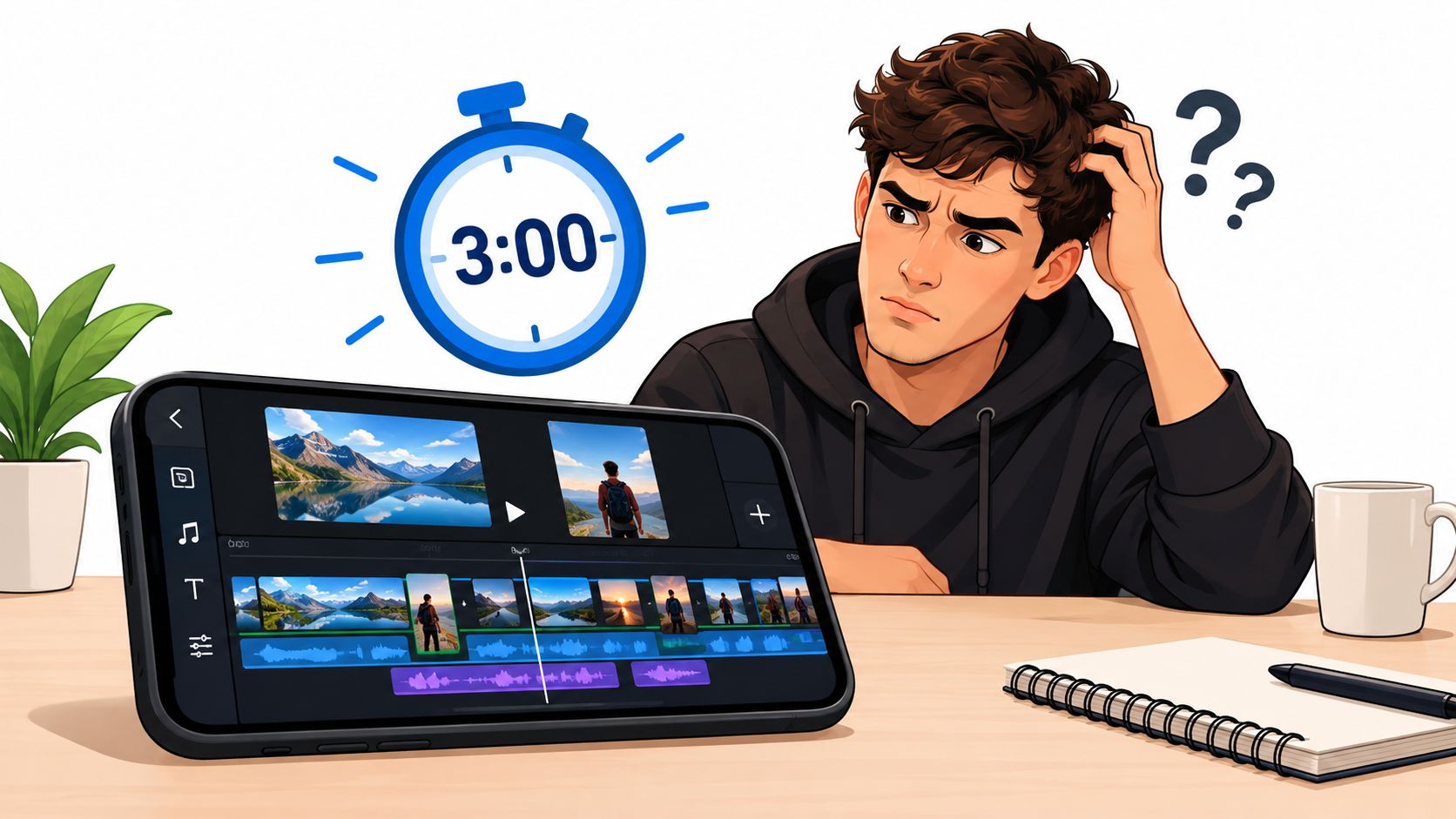
Instagram’s current product information allows Reels made from one or multiple clips totaling up to 3 minutes. That capacity suits tutorials, interviews, and gaming highlights that need room to develop. It remains a ceiling for uploads, not a recommendation for every edit.
Practical rule: Cut to the shortest version that makes the idea complete, then use retention data to decide whether the next version needs more context.
Horizontal footage makes this decision more visible. A pause that felt natural during a live broadcast can feel empty after the moment is isolated in a vertical feed. Crop the frame, then rebuild the sequence around the viewer’s reason to keep watching. Move the payoff earlier when the setup can be shortened, or preserve a brief explanation when removing it would make the result confusing.
Duration should follow editorial complexity. A single reaction or punchline may need only a compact setup and payoff. A tutorial may require additional steps, while a narrative clip may need enough space for tension to develop. Use the available runtime to support that structure, then remove every second that contributes neither understanding nor anticipation.
The right Instagram Reels length is the version that delivers its promised value before attention breaks. Review retention after publishing, and treat the next cut as an editorial test rather than a race toward the maximum.
The History of Instagram Reels Length Limits
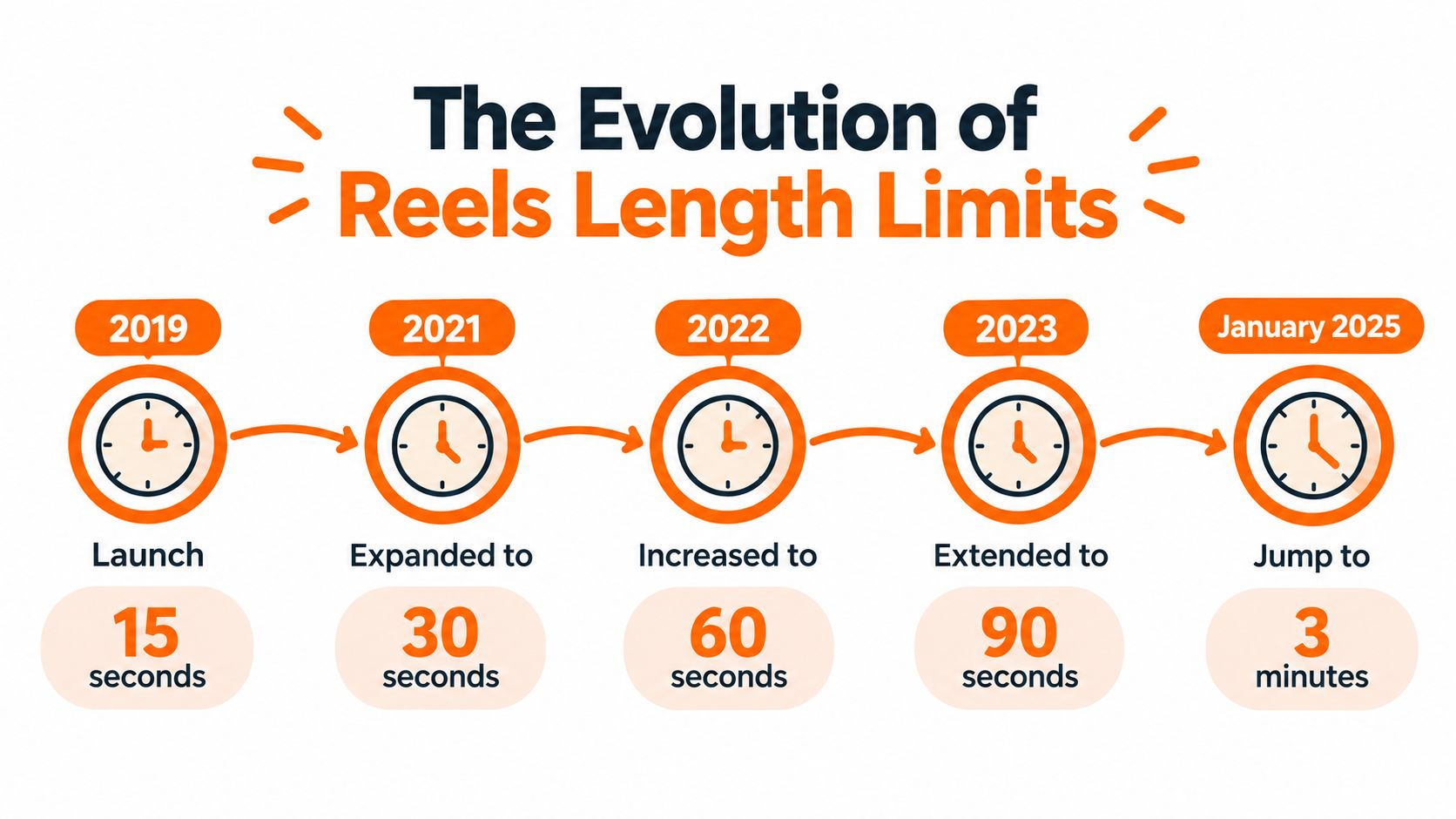
Reels began as a format built around very short, loopable clips. Instagram launched Reels globally in August 2020 with a maximum duration of 15 seconds, then expanded the limit to 30 seconds, 60 seconds, and 90 seconds before raising it to 3 minutes in January 2025, according to this documented history of Instagram Reel duration changes.
The ceiling therefore grew from 15 seconds to 180 seconds in roughly four and a half years. That change wasn’t merely a larger number in a settings menu. Each expansion altered what an editor could reasonably attempt.
What each expansion changed
At 15 seconds, the natural editorial unit was a rapid reaction, visual gag, dance, reveal, or loop. Editors had little room for explanation, so the opening image and payoff needed to work almost immediately.
The move to 30 seconds made room for a compact beginning, middle, and end. A creator could establish a problem, show the action, and deliver a result without relying entirely on the viewer already understanding the context.
At 60 seconds, tutorials, commentary, and short interviews became easier to structure. The extra time could support a useful explanation, but it also introduced more opportunities for hesitation, repetition, and weak transitions.
The 90-second limit helped longer gaming highlights and narrative clips breathe. A clutch sequence could retain enough setup to make the final play meaningful, provided the edit removed waiting, menus, and unrelated conversation.
The jump to 3 minutes supports deeper storytelling, interviews, tutorials, and gaming highlights. It also creates a workflow risk. An editing system designed around a fixed ultra-short target may start treating extra runtime as something to fill rather than space to justify.
Why old advice can mislead
Advice written for a 15-second or 30-second environment often assumes that every Reel should behave like a quick loop. That isn’t the only valid structure now, but the original lesson still matters: a longer canvas doesn’t create a stronger idea.
Creators should maintain several duration strategies instead of one universal preset. A single reaction may need only a few seconds. A mini-story may need more room. A tutorial may justify a longer cut if each section advances the explanation.
Maximum Upload Length vs Optimal Reel Length
Think of the platform maximum as a boundary, not a destination. Instagram can accept a Reel of up to 3 minutes, but a 180-second upload has to hold attention for far longer than a concise clip. The technical maximum answers whether the file can be uploaded. Distribution-optimized length asks whether viewers have a reason to continue at every point.
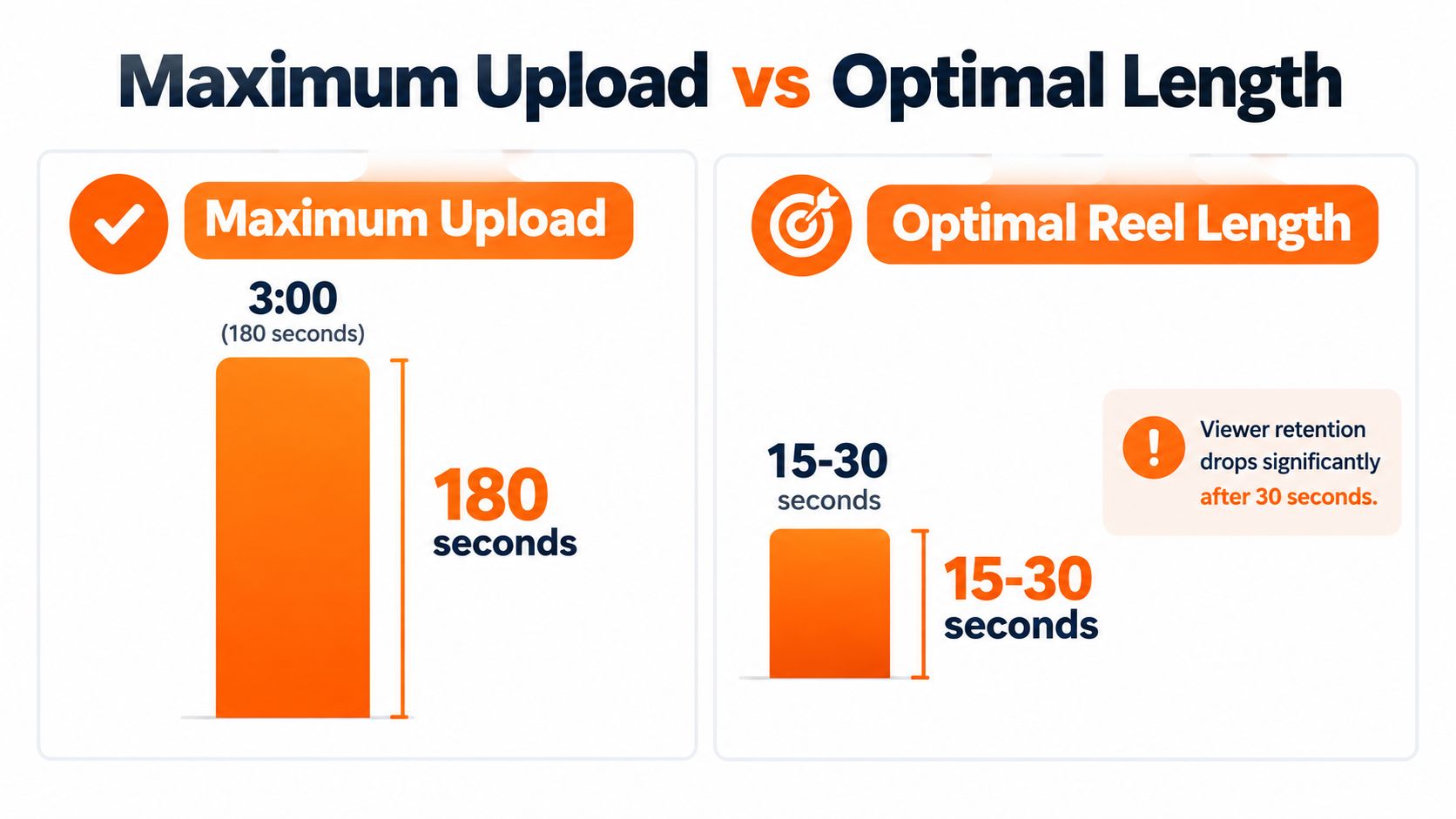
A three-minute gaming recording might contain the match-winning play, but also a long load screen, equipment discussion, menu navigation, and silence before the action begins. A 30-second edit can preserve the key setup, show the decisive move, and end on the reaction. The shorter version doesn’t automatically win, but it gives the viewer fewer chances to leave before the payoff.
Use the limit as an export requirement
For a repurposing workflow, the sensible technical preset is a 9:16 vertical master of up to 3 minutes. That preset keeps you inside the current official boundary while leaving room for clips that need more context. It shouldn’t dictate the runtime of every exported version.
Build the edit around three questions:
- Does the opening make sense without prior knowledge? If not, add only the context needed to understand the scene.
- Does every section advance the point? Remove pauses, repeated explanations, menus, travel, and conversational filler.
- Would separate clips be clearer? Split interviews, streams, or tutorials by topic instead of combining unrelated moments into one long Reel.
A 3-minute Reel can be appropriate when the story needs that room. It becomes a weak choice when the editor uses the platform limit to avoid making a decision. The goal is meaningful viewing per second, not maximum duration.
What Reels Length Data Says About Reach and Retention
Performance data points to a useful tension. A 2026 analysis cited by Socialinsider’s Instagram Reels statistics found that Reels between 30 and 60 seconds achieved the highest average reach rate at 5.60%. Clips shorter than 30 seconds reached 5.20%, while 60-to-90-second Reels reached 5.30%.
The reach rate declined to 4.30% for 90-to-120-second videos and 3.50% for videos longer than 120 seconds. The 30-to-60-second group therefore exceeded the longer-than-120-second group by 2.10 percentage points, or about 60% relative to the 3.50% figure.
| Duration Bucket | Average Reach Rate |
|---|---|
| Shorter than 30 seconds | 5.20% |
| 30 to 60 seconds | 5.60% |
| 60 to 90 seconds | 5.30% |
| 90 to 120 seconds | 4.30% |
| Longer than 120 seconds | 3.50% |
That makes 30 to 60 seconds a strong reach-oriented starting point, not a universal law. A short clip can still be the better choice when the idea is simple, and a longer narrative can justify its runtime when viewers remain engaged.
Reach isn’t the same as retention
A separate 2026 analysis of 346 Reels reported an average watch ratio of 66.0% for clips under 15 seconds, compared with 16.4% for clips longer than 60 seconds. Watch ratio means average watch time divided by total Reel duration, so longer videos must create proportionally more value to keep the same level of completion. The findings are summarized in this Instagram Reels performance report.
The same analysis reported the highest engagement per view for the 15-to-30-second group, at 9.1%. That result complicates the idea that the shortest possible clip is always best. A 15-second reaction may be ideal for a single moment, while a 25-second edit may generate more interaction because it gives the viewer a complete mini-story.
Use the figures as editorial signals:
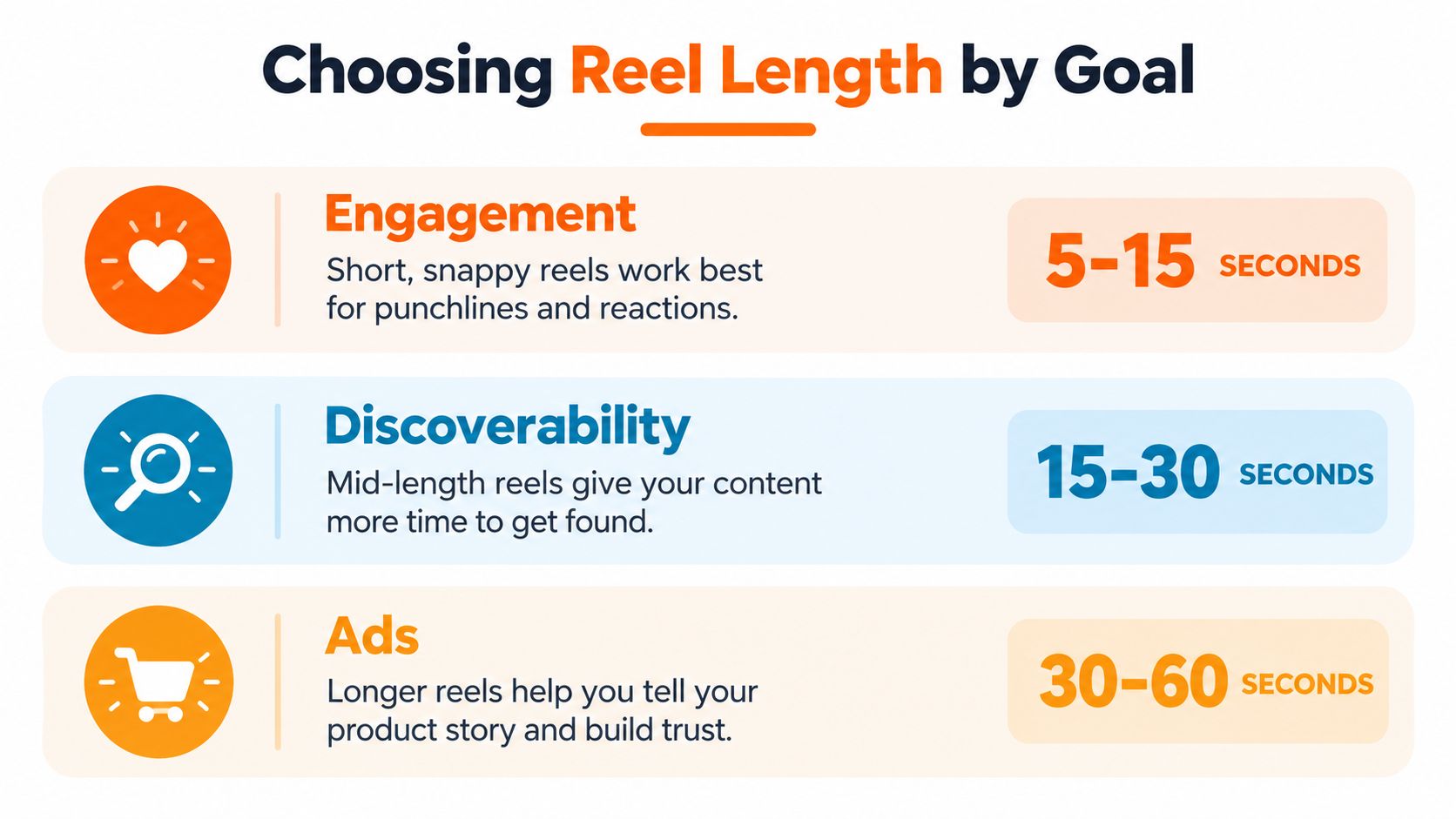
- Under 15 seconds: isolate one reaction, reveal, punchline, or gaming kill.
- 15 to 30 seconds: build a self-contained moment with just enough setup.
- 30 to 60 seconds: support a tutorial, explanation, or narrative that needs context.
- Beyond 60 seconds: keep the extra material only when it continues to earn attention.
For broader short-form comparisons, this guide to how long TikTok videos should be offers a useful reminder that duration works differently across formats and audiences.
Choosing Reel Length for Engagement, Discoverability, and Ads
Start with the purpose of the clip, not the length selector. A Reel designed to trigger a quick reaction needs a different structure from one designed to teach a process or explain a product.
Engagement needs immediate payoff
For a punchline, reaction, surprising fail, or single gaming moment, begin with the strongest visual and cut once the response lands. Sub-15-second edits are useful when the viewer doesn’t need background information. A reaction shot that depends on ten seconds of explanation probably isn’t a reaction clip anymore. Either tighten the setup or move the idea into a longer format.
A 15-to-30-second Reel works when the viewer needs a short sequence rather than one isolated frame. For example, a streamer can show the challenge, the risky decision, and the result in one compact arc. Remove greetings, repeated commentary, and the pause after the reaction.
Discoverability benefits from enough context
The reach data supports 30 to 60 seconds as a strong starting window for discovery-focused edits. That range can accommodate a practical tip, a concise explanation, a short interview answer, or a gaming highlight whose payoff needs setup. The condition is that the opening must establish the subject quickly.
A useful structure is:
- Opening: show the problem, outcome, or unusual moment.
- Development: provide only the context needed to follow it.
- Payoff: deliver the answer, result, or emotional release.
- Exit: end immediately after the idea lands.
Ads need clarity before persuasion
Product storytelling can stretch toward 60 to 90 seconds or longer when the audience needs a demonstration, comparison, or explanation. But an ad shouldn’t use extra time merely to repeat the product name. Show the use case early, make the benefit visible, and cut any brand language that delays the proof.
A longer sponsored Reel can succeed with a warm audience even when a shorter discovery clip would be better for broad reach. That trade-off is why length should follow the campaign objective. Engagement, discovery, and conversion don’t ask the viewer for the same commitment.
How to Trim Horizontal Footage Into the Right Reel Length
A horizontal recording gives you more visual width than a vertical feed can display. Start by deciding what deserves the center of the frame. Reframe the speaker, player, product, or action for 9:16, then review the crop at feed size. A technically correct conversion can still hide the important detail.
A practical workflow looks like this:
- Mark the outcome first. Find the winning play, strongest statement, reveal, or reaction. That moment often becomes the opening image or the endpoint of the first cut.
- Write the minimum setup. Keep the sentence, visual clue, or action that makes the outcome understandable. Remove context that only mattered to people watching the original long recording.
- Cut dead air aggressively. Delete menus, loading, travel, repeated questions, breathing space, and pauses before the core statement.
- Build the shortest complete version. Try a sub-15-second cut for one moment, 15 to 30 seconds for a mini-story, or 30 to 60 seconds for a tutorial or narrative that needs explanation.
- Split by topic. If one recording contains several useful ideas, export separate Reels instead of forcing them into one long sequence.
The crop and the cut need to support each other. If a speaker moves across the original frame, use subject-centric reframing so the person stays visible. If two people matter, alternate crops or use a deliberate split layout rather than shrinking both subjects until neither is readable.
For a practical guide to the technical side, see how to resize videos for vertical formats. Resizing solves the canvas problem, but it doesn’t solve pacing. You still need to decide where the viewer enters the scene and what they should understand before the payoff.
Let the source determine the duration
A single reaction shouldn’t become a 60-second Reel because the export preset allows it. Likewise, a 15-second crop can fail when it removes the setup that makes a clutch moment meaningful.
For streamers, inspect the footage in layers. The first pass finds moments. The second removes inactivity. The third checks whether the opening works without the original broadcast context. Only then should you add captions, sound effects, or transitions.
Editing test: If removing a shot changes neither the viewer’s understanding nor their anticipation, remove it.
Diagnosing the Right Reel Length From Your Own Retention Data
Universal sweet spots are useful for choosing a first cut, but they can’t tell you why viewers leave. A three-second drop-off might mean the Reel is too long, but it might also mean the opening is slow, the caption is unclear, or the first shot doesn’t match the promise.
Recent coverage describes Instagram retention-oriented insights added in 2025, including a playback drop-off chart and a skip-rate metric focused on early abandonment, as discussed in this analysis of Reel length and retention diagnosis. These signals let you inspect the shape of attention instead of judging the edit by total views alone.
Read the first drop-off before shortening everything
If viewers leave at second three, check the opening before cutting the ending. Ask:
- Does the first frame show the subject or outcome?
- Does the caption explain what the viewer is about to see?
- Does the spoken hook begin immediately?
- Is the crop hiding the relevant action?
- Does the opening promise something the next shot doesn’t deliver?
A high early skip rate can indicate a framing or hook problem rather than excessive total duration. Shortening the entire Reel may remove useful context while leaving the issue untouched.
Compare variants without changing the idea
For a strong clip, create duration variants that preserve the same core hook. A short version might show only the decisive gaming moment. A longer version might include the setup that explains why the decision mattered. Compare where viewers leave, whether retention stays stable through the middle, and whether the ending earns shares or rewatches.
A 90-second clutch sequence can outperform a 15-second crop when the shorter edit makes the payoff confusing. That doesn’t make longer videos generally superior. It means context is part of the value in that specific story.
The useful question isn’t “What is the perfect length?” It is “Which cut keeps the premise clear while losing the fewest viewers?”
Treat length as an outcome you refine after observing behavior. Tighten the intro when the first drop-off is severe. Remove a middle section when attention falls during explanation. Keep the longer narrative when retention remains stable and the ending gives viewers a reason to share or replay.
A Pre-Publish Reels Length Checklist
Before you export, run the clip through a quick editorial check. The goal is not to push every Reel into the same duration. It is to make sure the length has a clear job.
- Confirm the boundary: Keep the final Reel within Instagram’s current 3-minute official limit.
- Name the goal: Decide whether the clip is built for a reaction, a mini-story, a tutorial, discovery, or product storytelling.
- Choose the first target: Start under 15 seconds for one moment, 15 to 30 seconds for a complete mini-story, or 30 to 60 seconds when the idea needs context.
- Front-load the premise: Make the first seconds understandable on their own. Lead with the outcome, the problem, the visual action, or the clearest line.
- Remove nonessential time: Cut menus, pauses, repeated wording, greetings, and any shot that does not clarify the action or raise anticipation.
- Check the vertical frame: Keep faces, gameplay details, products, and captions readable in 9:16.
- Plan the next diagnosis: After publishing, inspect early skips and playback drop-off. Decide whether the next version needs a stronger opening, a shorter middle, or more context.
- Polish the captions: Use an auto subtitle generator as a starting point, then correct names, timing, and emphasis before export.
A short Reel works like a tight edit. Every second needs a reason to stay on screen. A longer one can work just as well when the setup and payoff need room to breathe. The best cut matches the story, the hook, and the viewer’s patience.
Instagram Reels length is an editorial choice shaped by content complexity and viewer behavior. The platform limit is only the outer boundary.