 clipoven
You can sit on a goldmine of footage and still get almost nothing from it if you treat repurposing like trimming. That old habit made sense when vertical video felt like an add-on. It doesn’t now. YouTube Shorts alone had 200 billion daily views by early 2026, up from about 70 billion daily views in March 2024, and was described in the same reporting set as having about 2 billion monthly active users according to these short-form content statistics.
That changes the job.
When you repurpose video content today, you’re not just trying to save editing time. You’re taking moments buried inside podcasts, webinars, interviews, livestreams, and demos, then packaging them for feeds that reward speed, clarity, and native feel. A strong horizontal moment isn’t automatically a strong Short. It has to be recut, reframed, and rewritten for the platform it lands on.
Table of Contents
- Why Repurposing Video Content Wins Right Now
- Finding and Framing Moments That Hold Attention
- Making One Clip Feel Native on Every Platform
- Captions Audio and Polish That Keep Viewers Watching
- Measuring What Worked and Iterating Fast
- Your Repeatable System to Repurpose Video Content
Why Repurposing Video Content Wins Right Now
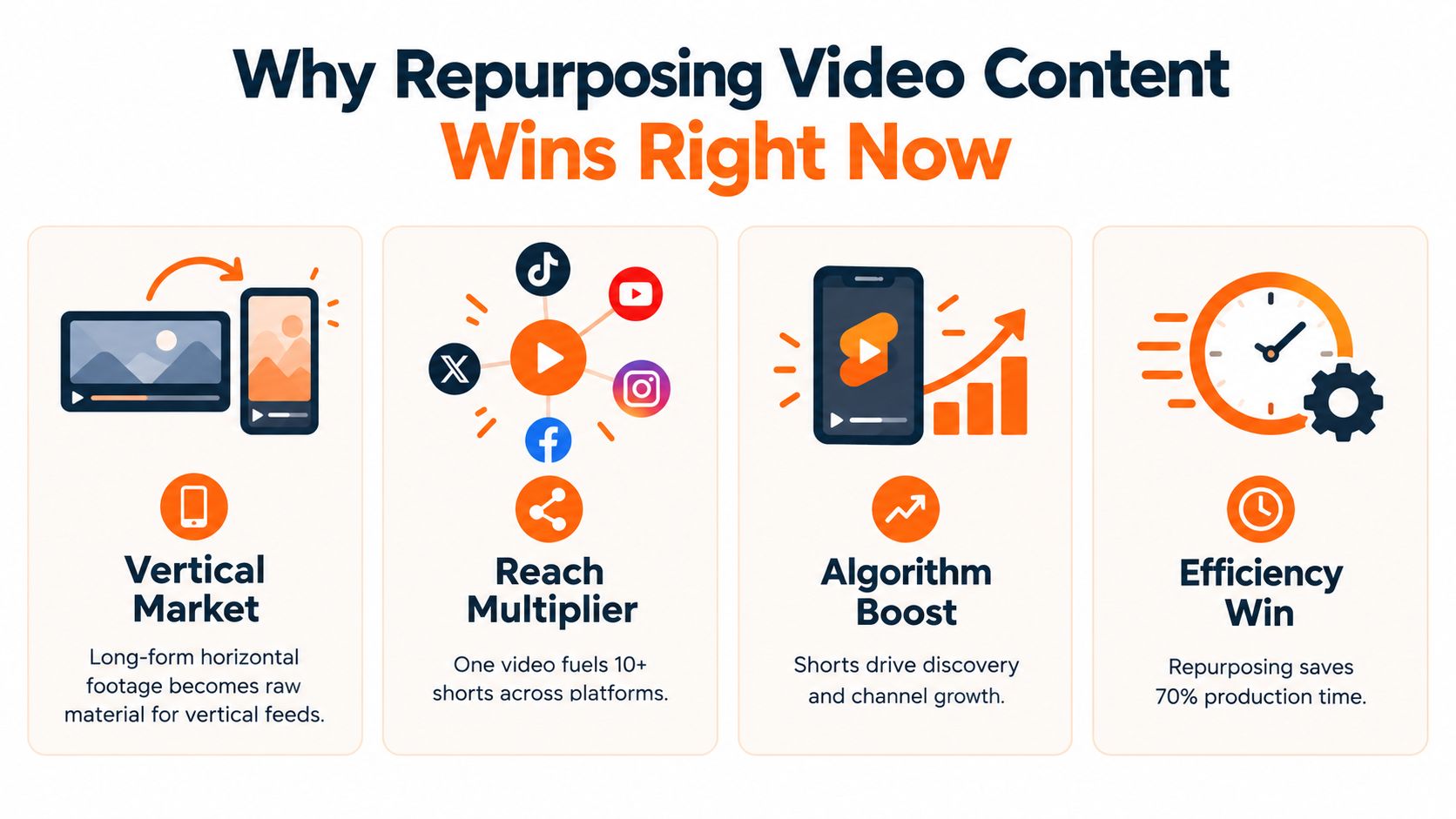
Short-form distribution is too large to treat as leftover work.
A long podcast, webinar, or stream can produce weeks of outbound video if the packaging is right. The missed opportunity usually is not production volume. It is failing to turn one recorded asset into multiple platform-native entries into the feed.
Repurposing is distribution work
Teams that already record long-form video often assume the archive is doing its job once the full episode is live. It usually is not. A 60-minute upload asks for commitment. A strong short clip earns attention first, then sends interested viewers deeper.
Analysts at TTCalculator’s repurposing ROI analysis found that posting a TikTok video to one additional platform usually takes 15 to 45 minutes, and that publishing the same source idea on YouTube Shorts can add 40 to 80% more views compared with TikTok alone. The same analysis estimated only 12 to 18% audience overlap between TikTok and Shorts.
That matters because repurposing is not just about getting more use from footage. It is a reach decision. In many cases, it is how a creator, media team, or brand gets in front of viewers who were never going to watch the original full-length upload.
One moment can carry more than one edit
Editors often lose performance here. They find a good 25-second answer, export it once, then post the same file to TikTok, Reels, and Shorts with minor caption changes. That saves time, but it leaves reach on the table.
The clip may need a harder opening on TikTok, cleaner on-screen text on Reels, and tighter pacing on Shorts. The source moment stays the same. The packaging changes.
That is the job.
The archive is usually better than teams expect
Horizontal footage already contains usable short-form inventory. Interviews contain sharp claims. Demos contain visible before-and-after moments. Livestreams contain reactions and mistakes, which often outperform polished talking points because they feel less staged.
The trade-off is editing time. Pulling more value from a library means spending real effort on reframing, captions, and opening lines. But that cost is still lower than producing a new video from scratch every time you need another post.
What makes repurposing worth it now
Three conditions changed.
First, vertical feeds became a primary discovery channel, not a side outlet.
Second, the same raw footage can perform very differently depending on how it is packaged for each platform.
Third, the production bottleneck shifted. For many teams, recording is no longer the hard part. Selecting, reframing, and shipping enough native-looking cuts is.
The channels that win here do not treat repurposing as cleanup after the edit. They treat it as a separate editorial pass with its own standards for hook strength, caption density, and pacing.
Finding and Framing Moments That Hold Attention
Editors who pull strong shorts from long-form footage are rarely finding the loudest moment. They are finding the moment with the cleanest tension.
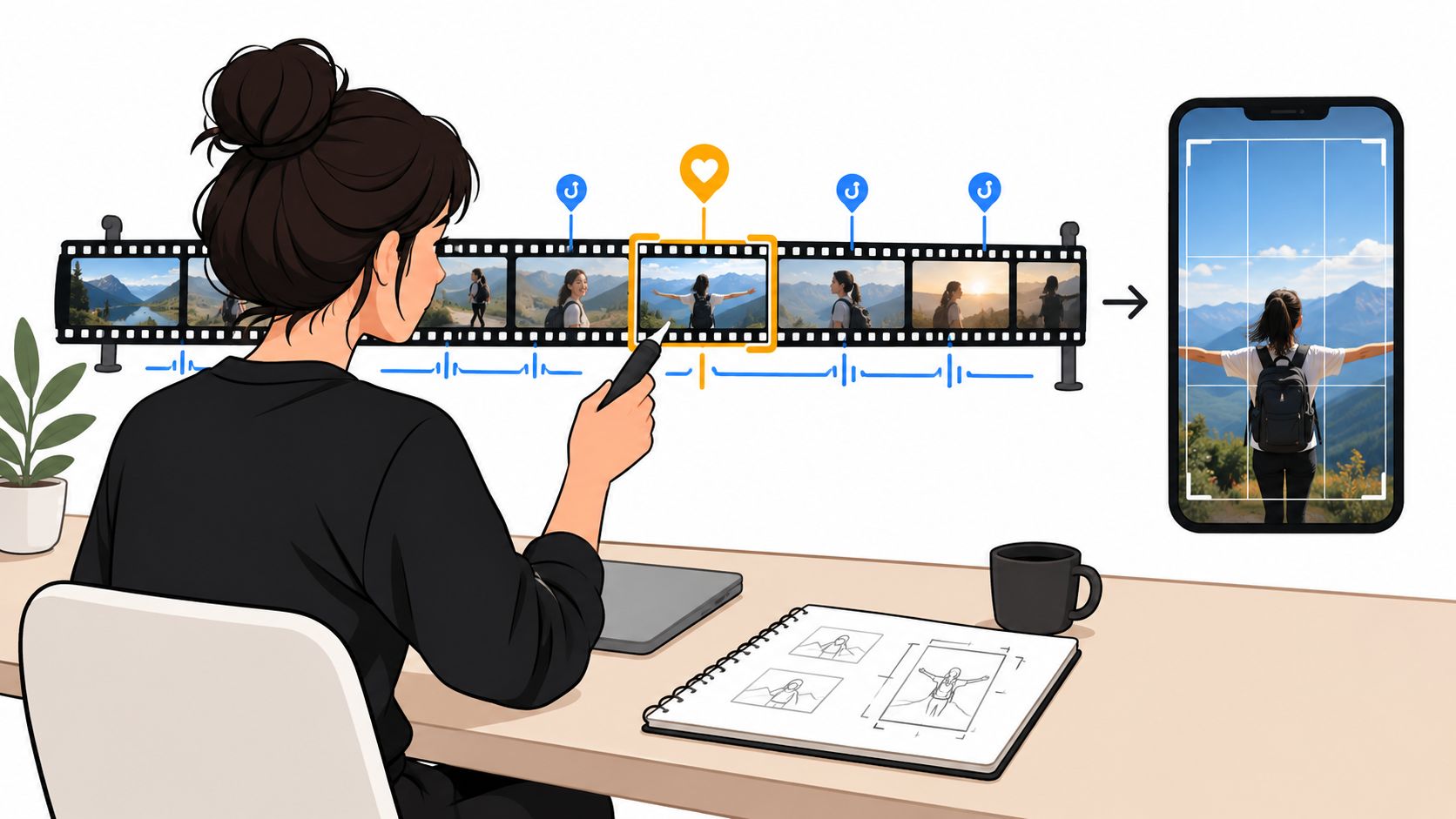
That usually means a line, reaction, reveal, or mistake that creates an immediate question in the viewer’s head. What happened? Why did they say that? Does the fix work? In a podcast, the keeper might be a blunt claim. In a sales demo, it is often the second right before the result appears. In a stream, a small unscripted reaction can outperform the polished takeaway because it feels earned.
The edit starts there.
Find the tension before you find the highlight
A lot of teams mark clips based on what felt important in the room. Short-form viewers do not care what the host spent five minutes building toward. They care whether the first beat gives them a reason to stay.
I look for moments that can survive outside the original timeline. If the clip needs too much setup, it usually dies in feed. If one sentence creates a gap that the next sentence closes, that is usable inventory.
A few patterns show up again and again:
- A claim with stakes. “We cut the wrong feature and signups went up.”
- A visible change. Before and after, wrong and fixed, attempt and result.
- An objection. “That sounds smart, but here’s why it failed.”
- A reaction that reframes the moment. Surprise, friction, embarrassment, relief.
- A line that promises a payoff. “The mistake was not the price. It was the onboarding.”
Those are better starting points than generic “best moments” because they already contain structure.
Rewrite the opening around feed behavior
Long-form speakers warm up. Short-form viewers swipe.
That changes the cut. The first usable line in a short is often buried 10, 20, or 40 seconds into the source. Good repurposing means lifting that line forward, then rebuilding context around it with captions, punch-ins, B-roll, or a fast setup card.
I usually test a candidate clip with one blunt question: if someone hears the first sentence with the sound low and zero context, do they still feel the pull? If not, the opening is weak, even if the overall moment is good.
This is also where platform-native packaging starts, not later. The source moment might stay the same, but the framing often changes by channel:
- TikTok usually tolerates a harder first line and faster information delivery.
- Reels often benefits from a cleaner open and less crowded on-screen text.
- Shorts tends to reward clips that get to the value immediately and remove extra throat-clearing.
Same raw moment. Different first impression.
A practical workflow for pulling clips from long recordings
When I am cutting a one-hour interview or stream, I do not hunt clip by clip in the timeline first. I use a selection pass that keeps me from overcommitting too early.
-
Skim the transcript for tension markers
Claims, disagreements, outcome lines, moments where the speaker changes tone, and any sentence that sounds quotable on its own. -
Pull wide selects
Grab more than you plan to publish. Include a few seconds before and after each moment so you have room to restructure the open. -
Test the first two seconds
Move the strongest line to the front if the original lead-in is soft. Add an on-screen setup only when the spoken hook cannot carry the clip alone. -
Cut the drag
Remove repeated words, verbal filler, slow reactions, and any explanation the viewer can get from text instead of speech. -
Make two or three versions
One version with a harder hook, one with a cleaner setup, one with a quicker payoff. TikTok, Reels, and Shorts start to split.
One good source segment often gives you several usable cuts. One of them usually wins clearly.
Strong shorts often start later than the speaker started talking.
You can do all of this manually in any editor. If you are processing a large library, agentic workflows can speed up the first pass. Tools such as Eddie inside ClipOven can propose cuts, captions, and effects from a brief, which is useful when you want a draft before making timeline-level refinements.
Reframe 16:9 footage with intent
A weak vertical crop looks accidental. The frame drifts. The product falls out of view. Captions fight the chin line. Viewers notice.
Good reframing is editorial, not mechanical. Decide what carries meaning in each beat, then crop around that. If the emotional read matters, protect the face. If the speaker is demonstrating something, protect the object even if that means giving the face less room for a few seconds. If two people are talking, decide whose reaction matters more rather than splitting the frame evenly and losing both.
A few habits help:
- Keep the eyes in a stable position so the frame does not feel like it is hunting.
- Protect gestures only when they add information. Not every hand movement deserves screen space.
- Use punch-ins selectively. One well-timed size change can reset attention. Constant fake zooms look nervous.
- Use B-roll to solve composition problems when the source framing gives you no clean vertical option.
Later in the process, it helps to study native pacing in motion rather than only on the timeline.
Build more options than you plan to ship
The mistake is not under-clipping. It is publishing every decent extract because it came from a good episode.
A long recording can contain ten valid ideas and only three strong openings. That difference matters. I would rather kill a respectable clip than post one that needs a paragraph of setup to work. The keepers usually feel simple on replay. One idea. One clear turn. One payoff.
Making One Clip Feel Native on Every Platform
The same moment can work on TikTok, Reels, and Shorts. The same export usually won’t.
That’s because each feed has its own tolerance for text, speed, and tone. A line that feels perfectly native on TikTok can feel overcooked on Reels. A clip that drifts into a payoff on Shorts may need a sharper opening statement to stop a TikTok user. The footage doesn’t need to change much. The packaging does.
What changes between platforms
Recent commentary on repurposing argues that real adaptation means reshaping the story, emotion, or payoff for Shorts, Reels, and TikTok rather than copying the same file everywhere, as outlined in these repurposing best practices for Shorts, Reels, and TikTok. I agree with that completely. Most underperforming cross-posts fail because they still feel like they belong to another app.
Here’s the simplest way to think about it.
| Element | TikTok | Instagram Reels | YouTube Shorts |
|---|---|---|---|
| Hook style | Often benefits from an immediate claim, tension, or curiosity punch | Usually works better when the opening feels polished and easy to read | Strong when the value lands instantly and the clip gets to the point fast |
| Caption density | Can handle denser text if the energy supports it | Cleaner layouts usually feel more native | Clear, readable captions with minimal clutter tend to travel better |
| Pacing | Tolerates harder cuts and faster tonal shifts | Often rewards slightly smoother flow | Benefits from tight pacing with clear informational progression |
| Visual treatment | Raw can work if intentional | Presentation often matters more | Framing and clarity matter because discovery is broad |
| Text language | More conversational and direct | Often cleaner and more branded | Usually best when concise and utility-driven |
| Watermarks | Remove them | Remove them | Remove them |
One source clip, three variants
Take a source moment from a podcast where the speaker says a common growth tactic stopped working.
On TikTok, I’d probably open with the strongest friction line first. Something blunt. Then I’d use quicker text reveals and let the captions carry more attitude.
On Instagram Reels, I’d soften the front edge slightly. Same idea, but cleaner entry, less caption clutter, and a more polished frame. Reels often punishes edits that feel too obviously imported from another ecosystem.
On YouTube Shorts, I’d trim even closer to the educational or payoff statement. Shorts viewers often reward clips that state the value early and stay clean through the middle.
If you’re resizing from horizontal and want the framing to stay readable, this guide on YouTube video size and ratio is a useful reference for layout decisions before export.
Hook and caption choices should match the feed
A practical way to package variants is to decide two things per platform before you edit:
- What kind of opener does this feed want? Curiosity, authority, emotion, or direct utility.
- How much text can the frame carry without feeling noisy?
That one decision prevents a lot of lazy reposting. You don’t need three separate edits from scratch. Usually you need three intros, two caption treatments, and one pacing pass per destination.
What doesn’t work is pretending all vertical feeds behave the same because they’re all vertical.
Captions Audio and Polish That Keep Viewers Watching
Captions decide whether a clip feels native to the feed or recycled from somewhere else.
In vertical editing, captions are not a compliance layer. They control reading speed, emphasis, and perceived pace. The same spoken moment often needs different caption density on different platforms. TikTok can carry more text and faster word changes if the tone is sharp. Reels usually performs better with cleaner frames and less on-screen clutter. Shorts tends to reward a simpler caption treatment that stays readable without pulling focus from the core point.
Several recent discussions of Shorts editing tie subtitles to stronger retention, especially when the text helps viewers follow the point with sound off, as covered in this analysis of subtitles and retention in Shorts.
Captions need to be readable before they look stylish
The practical rule is simple. If a viewer has to work to read it, the edit is already losing.
BBC subtitle guidance is a useful baseline here: keep captions short enough to scan quickly, which usually means about 4 to 6 words per line in fast-moving video contexts, according to the BBC subtitle style guide. That limit forces better editing decisions. You start cutting filler words, breaking lines on meaning, and giving the punch word room to land.
What hurts retention is not just bad typography. It is mistimed language. A strong quote can die because the keyword appears a beat late, or because three lines of text cover the speaker’s face right as the payoff hits.
Use captions as editorial control:
- Keep lines short so they can be read in motion on a phone.
- Break on meaning so each line feels intentional.
- Emphasize selectively. One or two highlighted words usually outperform full karaoke styling.
- Adjust density by platform. TikTok can handle more active text. Reels usually wants restraint. Shorts benefits from clarity first.
If you want an AI-assisted first pass on captions and timing, an automatic video editor can speed up assembly, but retention still improves in the manual pass.
Audio cleanup is part of the edit
Viewers will tolerate imperfect framing longer than they will tolerate ugly audio.
Phone speakers punish muddy mixes. Harsh compression, hiss, rumble, plosives, or music that masks consonants all create low-grade friction. People swipe before they diagnose the problem.
My export check is boring on purpose:
- Dialogue sits in front
- Music supports pace without masking words
- Cuts do not pop because the room tone changed
- Sound effects are sparse enough to feel deliberate
This is also where platform-native packaging shows up again. A dense, meme-styled TikTok cut can carry slightly more aggressive sound design. The same treatment on Reels often feels imported and overworked. Shorts usually benefits from cleaner dialogue and fewer audio jokes unless the clip is built around entertainment first.
Polish the frame without burying the point
Extra motion does not create retention by itself. Clear information does.
Punch-ins, screenshots, reaction crops, progress bars, and on-screen labels should each answer a question: does this help the viewer understand the moment faster? If yes, keep it. If it only makes the timeline busier, cut it.
The final polish should make the clip feel easier to watch, not more edited. That difference matters. A vertical short that feels native to TikTok, Reels, or Shorts usually has fewer layers than editors expect, but every layer is doing a specific job.
Measuring What Worked and Iterating Fast
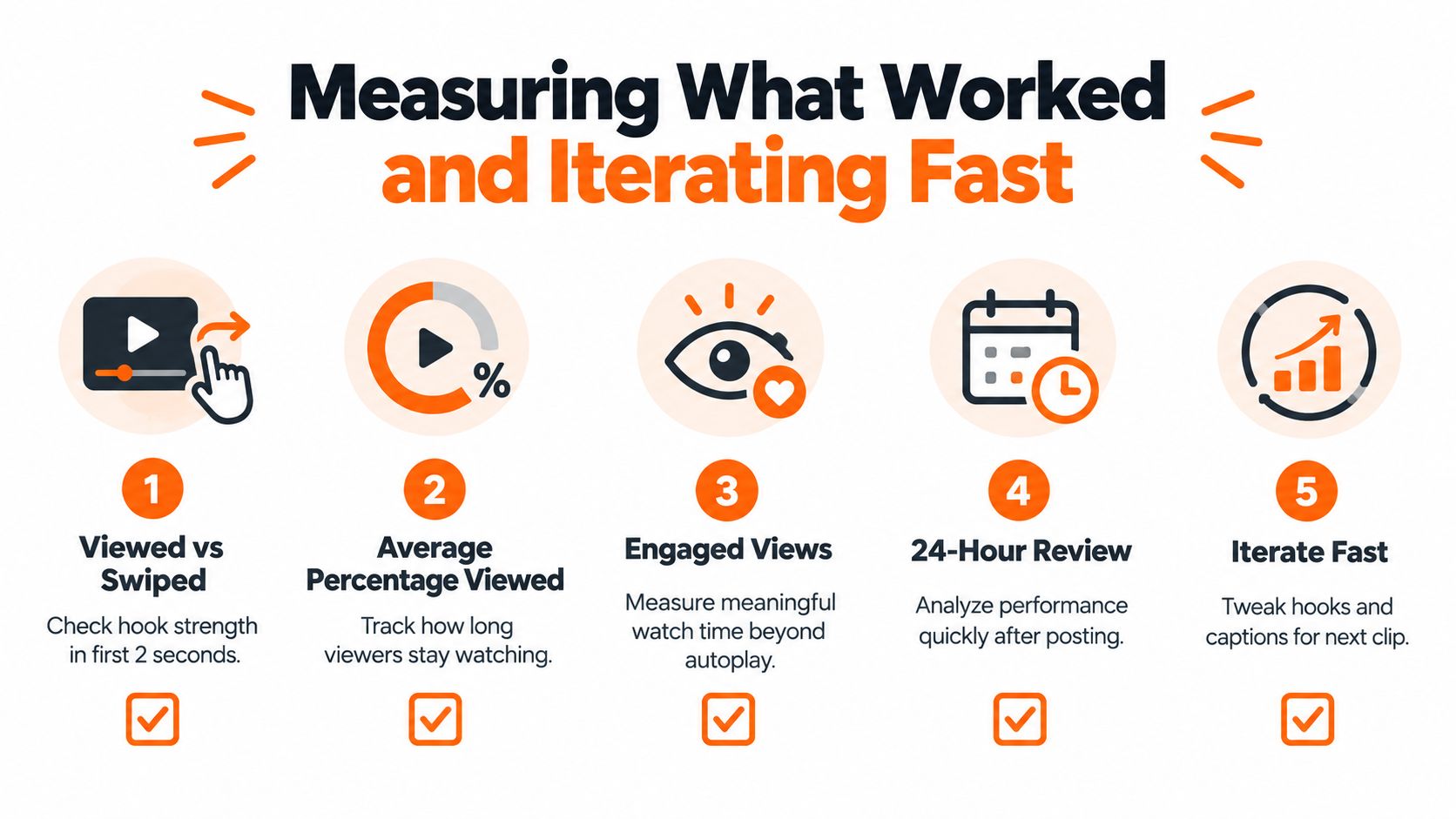
A short usually succeeds or fails in the first few seconds. The useful question is not whether a clip got views. It is where attention broke, on which platform, and whether the packaging matched how that audience watches.
A lot of teams review short-form like it is one format. It is not. The same clip can stall on Reels, hold on Shorts, and get decent completion on TikTok for three different reasons. TikTok often tolerates a faster, harder hook and denser captions. Reels tends to punish cuts that feel too obviously imported. Shorts usually exposes weak setup fastest because viewers expect the point early.
What to check in the first 24 hours
Start with stop rate and hold rate, then compare platform versions side by side.
If viewers are swiping immediately, the opener did not earn attention. If they stay through the first beat and leave after that, the problem is usually packaging or structure, not topic. I check the same four failure points first:
- The promise in the first line was too vague
- The clip took too long to explain why the moment mattered
- The visual pace slowed while the speaker was still talking
- The platform version used the wrong caption density or pacing
Comments help, but retention tells you where to look. A spike in comments saying “get to the point” usually confirms what the graph already showed.
Read retention by clip length and by platform
A 14-second clip and a 52-second clip should not be judged the same way. Neither should a TikTok cut and a Shorts cut built from the same source moment.
I use retention as editing feedback, not as a universal scorecard. Short clips need a stronger hold because there is less to ask from the viewer. Longer clips can survive a small dip if the payoff is strong enough to pull people back. Platform context matters too. On TikTok, a busy opener can buy you another second. On Shorts, that same opener can feel noisy if the spoken idea is simple. On Reels, I often see cleaner frames and lighter captioning hold better for expert or creator-led clips.
That is why repurposing is a packaging job. If one version underperforms, do not rewrite the whole concept yet. Check whether the hook style, subtitle load, and cut speed fit the platform where it was posted.
Fix the exact second that lost the viewer
Broad conclusions slow teams down. “This topic did not work” usually means nobody checked the drop.
Open the retention graph and inspect the first visible decline. Then ask a narrow question:
- Did the opening line promise a payoff the clip delivered too late?
- Did the frame stop changing while the speaker was still building the point?
- Did the captions get too dense to read at speed?
- Did this version keep a beat that worked in long-form but dies in vertical?
Those questions lead to edits you can ship today. Cut one half-second reaction pause. Move the result line to second one. Reduce subtitle density on Reels. Keep the faster text rhythm on TikTok. Trim the throat-clearing sentence from the Shorts version.
The editors who improve fastest are not guessing better. They are running cleaner tests, spotting the exact drop, and changing one thing at a time on the next batch.
Your Repeatable System to Repurpose Video Content
The easiest way to burn out on short-form is to reinvent your workflow every time. Repurposing starts working when the process gets boring in a good way.
You need a system that turns one long recording into a small batch of viable native shorts, then uses performance feedback to sharpen the next batch. That keeps the work focused. It also stops you from overediting weak moments and underediting strong ones.
A weekly repurposing system that actually holds up
Start with one source video that has clear spoken ideas. Podcasts, interviews, tutorials, and streams usually give you enough range.
Then run this sequence:
- Pull candidate moments first. Don’t open the timeline trying to finish clips immediately.
- Choose only standalone ideas. If the viewer needs missing context, skip it or rebuild the setup.
- Create platform variants before export. Change the opener, caption density, and pacing where needed.
- Add captions and cleanup. Make sure the clip survives muted playback and phone speakers.
- Review early performance. Keep notes on hook strength, drop-offs, and what held.
A lot of teams save time by batching roles instead of batching complete clips. One pass for selects. One pass for reframing. One pass for captions. One pass for native packaging.
Keep the workflow light enough to repeat
The point isn’t to squeeze every possible second out of every long video. That usually creates filler. The point is to produce a reliable stream of clips that each have a reason to exist.
A stable system usually includes:
- A source library with transcripts or searchable footage
- A shortlist habit so strong moments don’t get lost
- A variant rule for TikTok, Reels, and Shorts
- A publish checklist that catches watermark, framing, caption, and audio issues
- A review loop tied to actual viewer behavior
If you want to automate more of the assembly side while keeping manual control for the final pass, an automated video editor can help structure the workflow without turning every clip into the same template.
What to do this week
Pick one strong long-form video. Don’t try to repurpose the entire thing.
Pull a few candidate moments. Build three native versions from the best one. Publish them where they belong, then check the first-day data closely enough to learn something from each cut.
That’s how you repurpose video content in a way that compounds. Not by posting more clips. By packaging the same source footage so each platform gets a version that feels like it was made for that feed.
If you’re cutting horizontal podcasts, streams, or interviews into vertical content regularly, clipoven is built for that workflow. It uses an AI editing agent to propose cuts, captions, and effects from your source footage, then gives you a full editor to refine pacing, reframing, and final polish before you publish.