 clipoven
Under 15 seconds maximizes completion, while 45 to 60 seconds can win on views and engagement. The right answer to how long should Reels be depends on whether you’re optimizing for completion, engagement per view, or raw reach.
That trade-off matters because Instagram Reels don’t reward one universal length. The data points in different directions, and the strongest creators choose a duration band based on the KPI they need most, not on habit or imitation. A short clip that finishes cleanly can outperform a longer one on completion, while a more substantial cut can earn more saves and shares when the structure holds attention.
Table of Contents
- Why Reel Length Is Really a Metric Question
- How Retention Drops as Reels Get Longer
- Comparing the Three Realistic Duration Bands
- An Editing Workflow for Hitting Your Target Duration
- Matching Reel Length to the Footage You Started With
- Why Shorter Is Not Always Better for Views
- Choosing the Right Length Before You Hit Publish
Why Reel Length Is Really a Metric Question
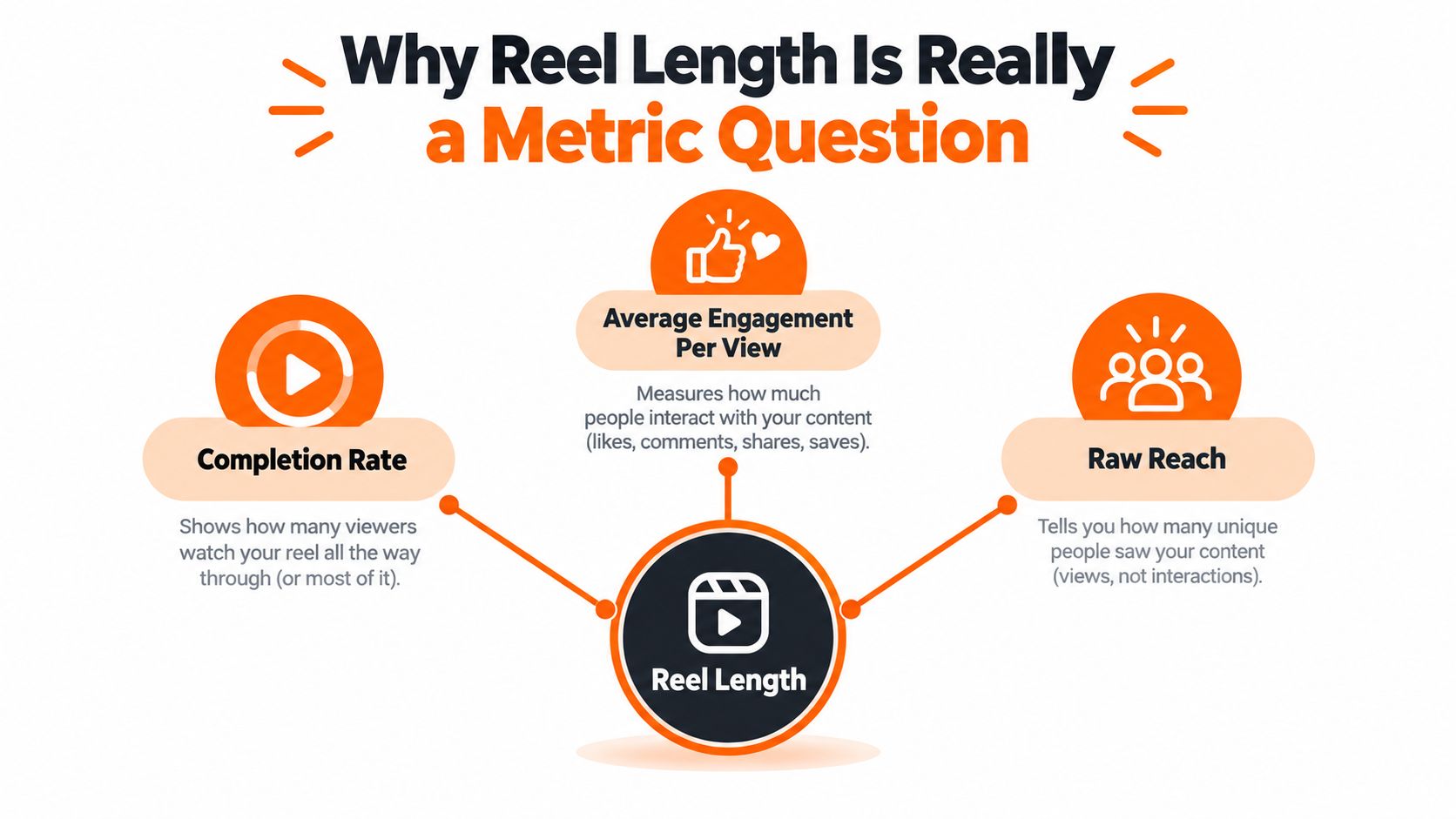
Reel length isn’t one decision, it’s three different ones disguised as one. If you care about completion rate, you want the shortest cut that still delivers the payoff. If you care about average engagement per view, you need enough runway for a viewer to react, save, or share. If you care about raw reach, you need a version that the platform can keep distributing after the first wave of viewers responds.
Three signals pull in different directions
Instagram’s current ceiling is no longer the whole story. YouTube Shorts can now run up to 3 minutes after the October 15, 2024 policy update, which shows how short-form strategy has moved away from a single hard cap, even though creators still usually optimize well below the maximum (YouTube Help Center). Reel strategy works the same way in practice, because the format is judged through retention, reactions, and downstream distribution, not just runtime.
A clip made for completion behaves differently from one made for saves and shares. Under 15 seconds is usually the safer bet when you want the viewer to finish the entire thing, while longer cuts can earn more total interactions if the content has real structure. That’s why copying a competitor’s runtime is often a category error. A product reveal, a meme, and a tutorial don’t ask the audience for the same commitment.
Practical rule: choose the duration that best serves the signal you want the platform to notice first.
The rest of the logic follows that split. Completion-heavy clips reward tight pacing, engagement-heavy clips reward a clearer payoff, and reach-heavy clips need enough viewer value to keep the recommendation loop alive. The decision is less “how short can I make this?” and more “what do I want this specific Reel to prove?”
How Retention Drops as Reels Get Longer
Retention doesn’t fall in a straight line, it drops in bands. A 2026 benchmark of Instagram Reels found that clips under 15 seconds kept 66.0% of their length in watch time, while clips over 60 seconds kept only 16.4%, with a 31.4% median retention across the sample (HighViz Reels report). That gap is the reason duration matters so much. Once the runtime crosses a minute, every extra second has to earn attention immediately.
The cliff past one minute is the real story
The same benchmark shows why the one-minute mark matters more than a neat round number. Under 15 seconds, viewers can tolerate more directness and still finish. Past 60 seconds, the odds of a clean finish collapse, so the edit has to work harder on the first hook, the mid-point, and the closing payoff. A Reel that rambles after the opening beats is likely to lose viewers before the value lands.
Another 2026 analysis found that average YouTube Short length sat at 33 seconds, with median views peaking at 11 to 20 seconds at 901 median views, then dropping to 347 for 31 to 45 seconds, 188 for 46 to 60 seconds, and 51 past 90 seconds (Piktochart benchmark). The pattern supports the same editorial instinct on Reels, the shortest version that fully delivers the payoff usually wins.
A viewer swipes after the third weak beat. Once that happens, the platform has a weaker reason to keep widening distribution.
A length problem usually starts as a pacing problem. If the opening takes too long to pay off, the viewer exits before the middle can help. That is why the shortest clips often look cleaner in analytics, especially when the goal is completion rather than extended narrative. For teams that script and recut often, this is also where automation helps, and tools like ClipOven’s editing workflow can speed up the trim-and-test cycle.
| Duration Band | Median Completion Rate | Median Views | Notes |
|---|---|---|---|
| Under 15 seconds | 66.0% retention in the benchmark cohort | Not provided in the verified data | Strongest on finish rate and replay potential |
| Over 60 seconds | 16.4% retention in the benchmark cohort | Not provided in the verified data | Requires a much stronger narrative spine |
| Overall median | 31.4% retention | Not provided in the verified data | Useful as a baseline, not a target |
Comparing the Three Realistic Duration Bands
The practical comparison isn’t between every possible Reel length. It’s between under 15 seconds, 15 to 30 seconds, and 45 to 60 seconds, because those are the bands where the data gives creators usable direction. Each one serves a different job, and the best choice depends on which metric matters most.
Under 15 seconds wins on finish rate
The shortest band is the most efficient when the content has one job and one payoff. It’s the cleanest fit for hooks, memes, quick product reveals, and any clip that needs the audience to understand it immediately. The 66.0% watch-time retention figure for clips under 15 seconds in the HighViz benchmark makes that clear (HighViz Reels report).
This band is also the easiest to loop. That matters because a rewatch can give a short Reel another chance to collect engagement signals without asking for more time from the viewer. If your clip depends on instant clarity, keep it here.
15 to 30 seconds often balances views and engagement
The middle band is where many creators find the best compromise. In one 2026 analysis, reels in the 15 to 30 second range produced the strongest engagement per view at 9.1% (HighViz engagement report). That makes this bracket a strong candidate for creators who want interaction density without drifting into slow pacing.
This is the most useful band for tutorials, explainers, and simple narrative arcs. It gives the viewer enough time to understand the point and react to it. If you’re optimizing for a balanced outcome, this band is usually the first one to test.
45 to 60 seconds can win when the structure supports it
The longer band is the one many creators underrate. Another 2026 business-account analysis found that reels in the 45 to 60 second range generated the highest median views and strongest engagement rate in that sample, with a median of 10,374 views for that bracket versus 4,700 for reels under 30 seconds (HighViz business-account study). That doesn’t mean longer is automatically better. It means the format can work when the content has multiple beats and the account already has a reason for viewers to stay.
Read the metric first, not the runtime. If the goal is saves or shares, a longer Reel can be the right edit. If the goal is completion, it probably isn’t.
The technical takeaway is simple. Under 15 seconds is the completion-first band. 15 to 30 seconds is the balanced band. 45 to 60 seconds is the narrative band, especially when the content earns attention across several moments.
| Duration Band | Completion Rate | Median Views | Engagement per View | Best For |
|---|---|---|---|---|
| Under 15 seconds | 66.0% retention in the benchmark cohort | Not provided in the verified data | Not provided in the verified data | Hooks, memes, product reveals |
| 15 to 30 seconds | Not provided in the verified data | Not provided in the verified data | 9.1% | Tutorials, explainers, balanced reach |
| 45 to 60 seconds | Not provided in the verified data | 10,374 in the business-account sample | Not provided in the verified data | Storytelling, brand accounts, multi-beat narratives |
An Editing Workflow for Hitting Your Target Duration
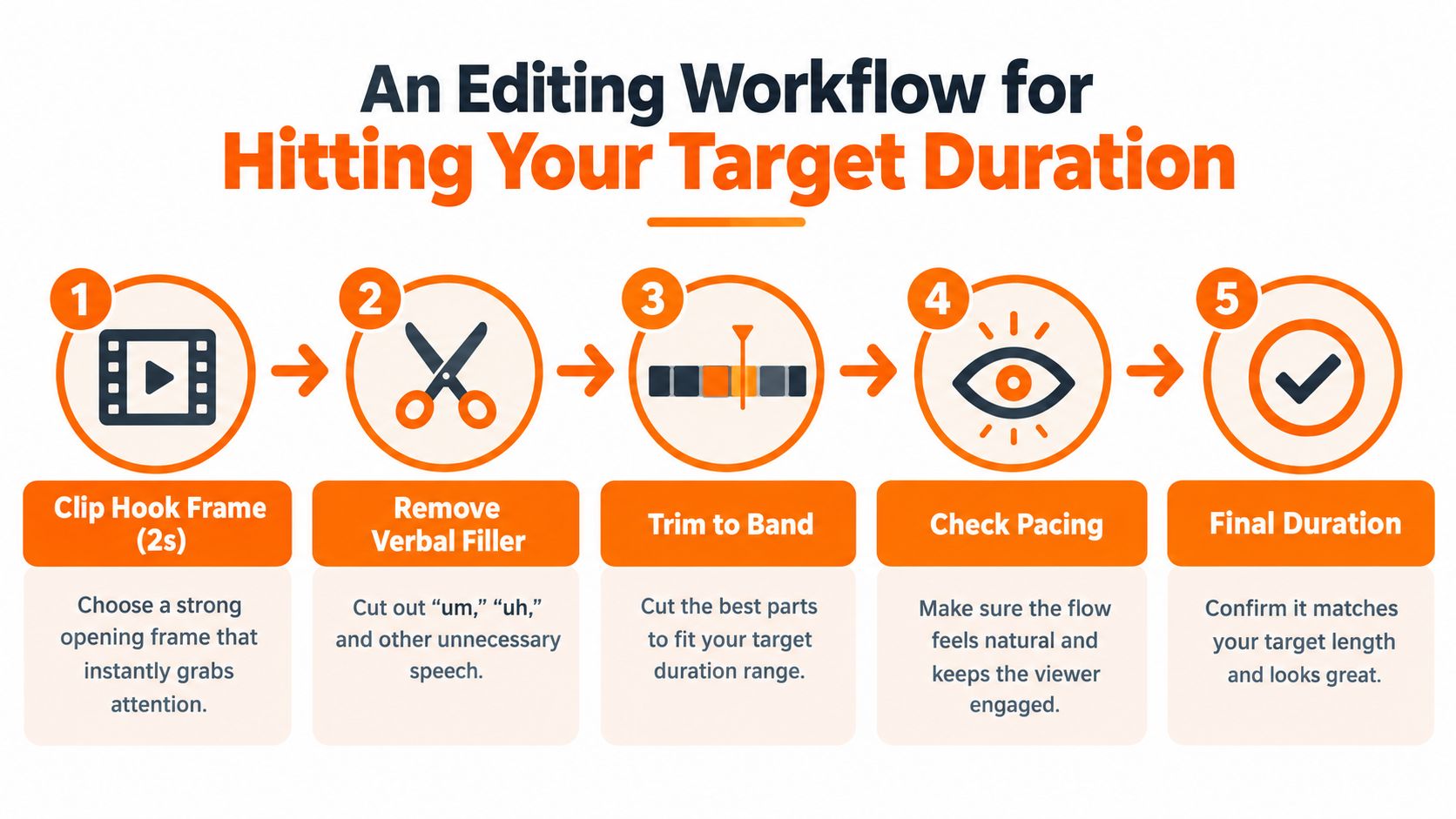
A target duration only works if the edit supports it. The fastest way to miss the mark is to start trimming randomly, because then the Reel loses either its hook or its logic. A cleaner process is to pick the destination band first, then cut the footage to serve that runtime.
Start with the hook frame, not the timeline
The first move is to find the most watchable opening moment, usually the cleanest 2-second hook frame. That opening has to answer one question fast enough to stop the scroll. If the source footage doesn’t do that early, no amount of trimming later will rescue the Reel.
Then cut verbal filler from the transcript. Tools like automatic video editing workflows help here because they make it easier to remove pauses, repeats, and soft openings without destroying the structure. The goal is not speed for its own sake, it’s removing seconds that don’t change the viewer’s understanding.
Match payoff timing to the band
Once the opening is tight, the payoff has to land inside the target window. For a clip under 15 seconds, the value needs to arrive early enough that the viewer feels the clip is already earning its keep. For a 45 to 60 second Reel, a second hook or fresh beat around the middle keeps the audience from feeling the segment drift.
A useful edit rhythm is to keep visual changes moving every few seconds so the frame never settles into dead air. That’s especially important for talking-head footage, where the camera angle is static and the viewer has to stay interested through language rather than motion. The pacing goal is consistency, not frantic cutting.
Keep the first pass brutally short. If the clip still feels complete after you remove the safe seconds, the runtime was probably padding.
A long source clip can be repurposed into multiple Reels if the beats are strong enough. A 90-second talking-head recording can become a short hook clip, a mid-length explanation, and a longer narrative version, each with its own purpose. That approach keeps the audio and visual logic intact while letting each cut serve a different KPI.
Matching Reel Length to the Footage You Started With
The source footage should decide the duration more than the calendar or the trend cycle does. A Reel built from a natural one-question answer should not be stretched just to “use” more footage. A tutorial or highlight reel, on the other hand, often needs more room because the viewer has to follow a sequence.
Talking head, tutorial, and highlight each want a different band
A 40-second talking-head clip where the speaker answers one direct question usually performs best once it’s cut down to roughly 12 to 18 seconds. The tangents disappear, the answer lands sooner, and the viewer gets a cleaner finish. If that same insight is padded to 55 seconds, completion tends to suffer, because the format no longer matches the content’s natural stopping point.
A step-by-step tutorial usually needs more room, often around 30 to 50 seconds, because each step needs its own beat. Cutting it too tightly can make the instructions feel rushed and harder to follow. In that format, the viewer is watching for clarity and sequence, not just for a quick reveal.
A 90-second gaming highlight can benefit from a 45 to 60 second edit if the build-up is part of the payoff. The audience wants the tension, the setup, and the release. That is where a longer cut can beat a shorter one, because the rewatch value comes from the structure, not from the clock.
| Footage Type | Recommended Duration | Metric Optimized |
|---|---|---|
| Talking-head answer clip | 12 to 18 seconds | Completion |
| Step-by-step tutorial | 30 to 50 seconds | Clarity and follow-through |
| Gaming highlight | 45 to 60 seconds | Views and engagement |
Repurposing footage effectively works best when the edit respects the clip’s natural stopping point. A format with one clear answer belongs in the shorter band. A format with multiple beats can justify more time.
Why Shorter Is Not Always Better for Views
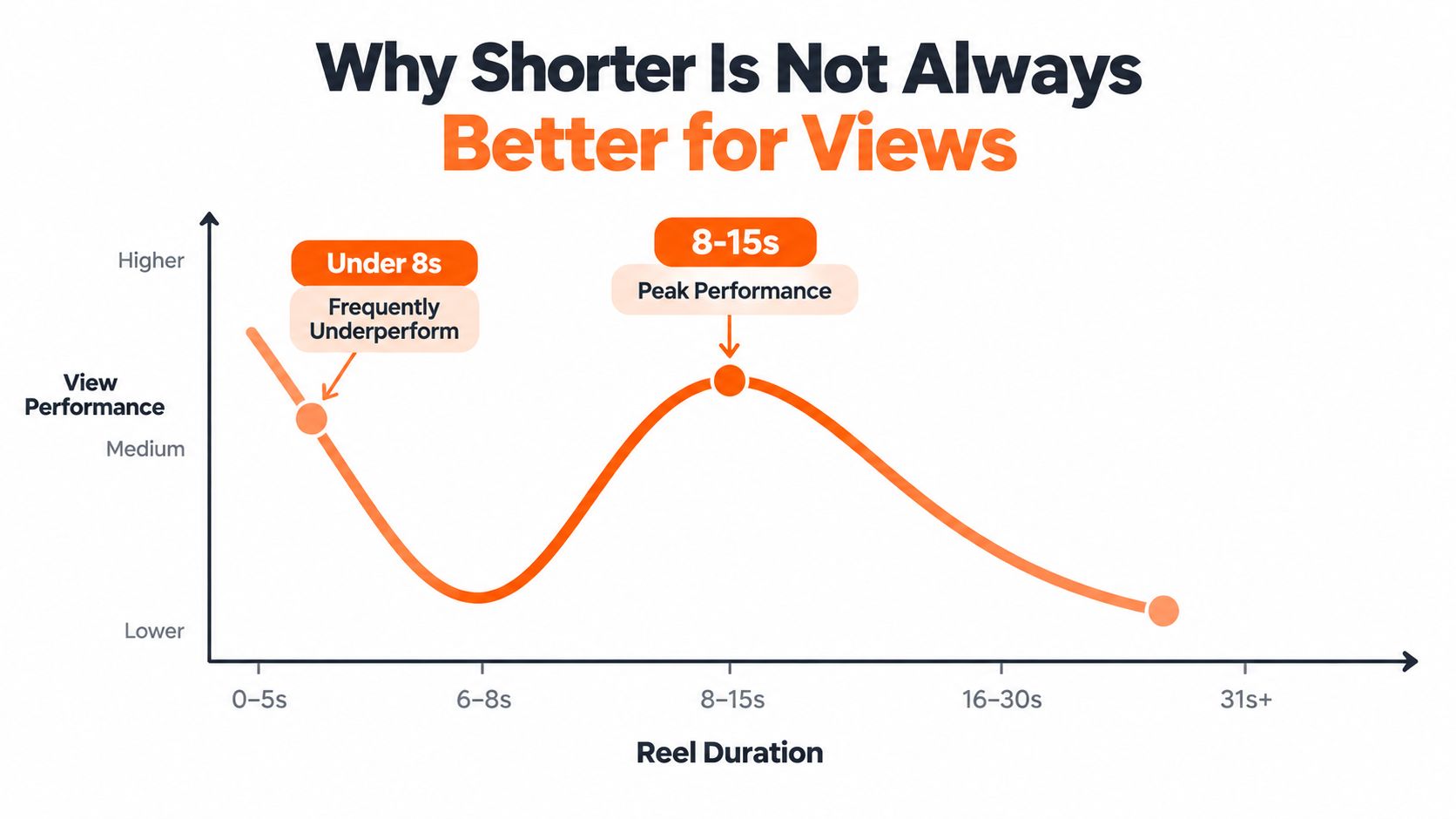
Shorter clips often win on finish rate, but finish rate isn’t the same as view performance. The current Reels data shows a more complicated shape, and the most useful way to think about it is as a U-shaped pattern rather than a simple “shorter is better” rule. That’s especially important for brand accounts and educational content, where a slightly longer edit can collect more total interactions per impression.
Very short clips can underperform when the hook is too thin
Reels that are too short can fail for a simple reason, they don’t leave enough room for engagement to build. If the viewer gets the point immediately but doesn’t have a reason to react, save, or share, the clip can look efficient and still underdeliver on distribution. That’s why ultra-tight editing isn’t automatically the same thing as strong performance.
The 2026 business-account benchmark supports that idea. In that sample, reels in the 45 to 60 second band produced the strongest median views, and the source described the pattern as U-shaped rather than linear (SocialInsider benchmark). The message is that length only works when the content structure can sustain it.
Longer clips can compound engagement per impression
A longer Reel doesn’t need to beat a short clip on completion to outperform it on outcome. If the viewer watches long enough to save, share, comment, or replay, that single impression can generate more total engagement than a quick clip that ends before the reaction forms. That’s why the strongest length depends on what you’re trying to measure.
The same logic explains why brand and creator accounts can get different results from the same runtime. A talking point that needs context may lose on completion but still win on total value if the audience actually cares about the subject. In that setting, the question isn’t “Can I shorten it more?” It’s “Would shortening it remove the very signal I need?”
Choosing the Right Length Before You Hit Publish
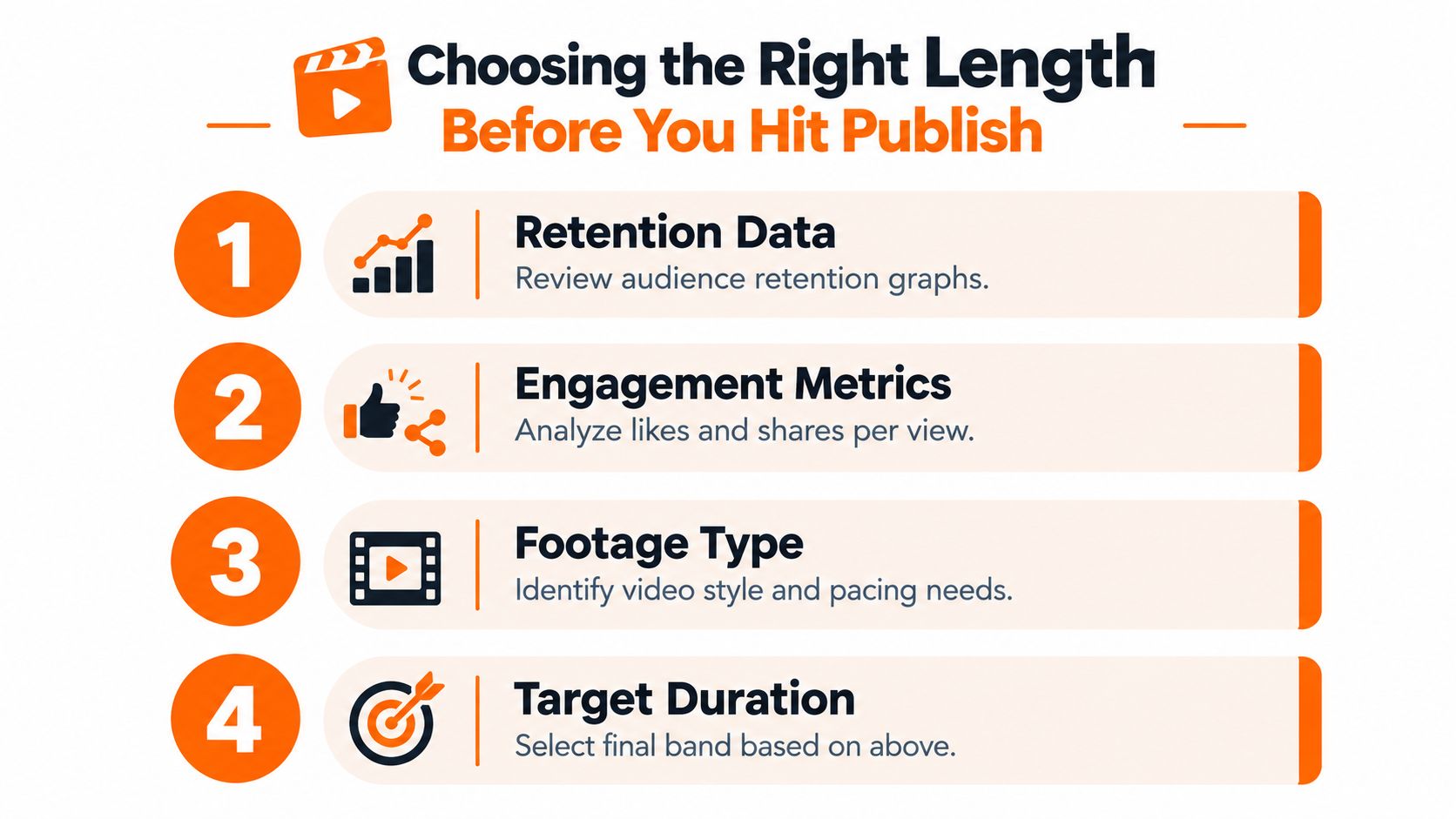
The cleanest pre-publish rule is to work through the decision in order. First, pick the primary metric. Then match the footage type to the nearest duration band. After that, check whether the first three seconds carry a strong hook, and finally confirm the closing frame gives the viewer a reason to save, share, or keep watching.
A simple publish check
- Pick the metric first: Decide whether this Reel should maximize completion, engagement per view, or raw views.
- Match the footage type: Use the shortest band that still fits the material, not the band that looks trendy.
- Stress-test the opening: If the first three seconds don’t make the point obvious, trim again.
- Check the ending: The last frame should support a save, share, or replay, not just stop.
A useful worked example is a 52-second tutorial. If completion is the priority, it usually gets clipped to about 28 seconds so the steps land faster and the viewer reaches the payoff earlier. If the goal is deeper explanation or save behavior, keeping more of the structure can make sense. That’s why the same raw footage can legitimately become two different posts.
One exception is evergreen pillar content designed for save-and-return viewing. That’s the rare case where extending beyond 60 seconds can still be defensible, because the audience is treating the Reel more like a reference asset than a quick hit. For everything else, the safest rule is straightforward.
Use 7 to 15 seconds for completion-driven clips, 20 to 30 seconds for balanced reach, and 45 to 60 seconds for save-optimized explainers.
If you’re clipping longer footage into tighter Reels, ClipOven can help turn source video into vertical shorts with reframing, captions, and editable cuts inside one workflow. Visit clipoven if you want a faster way to test different Reel lengths without rebuilding each version from scratch.