 clipoven

Make it shorter, post it everywhere, ride a trend. That’s still the most common answer to how to make videos go viral, and it’s the fastest way to waste good footage. A clip doesn’t travel because it’s short. It travels when the idea, the edit, and the platform’s audience fit together well enough that strangers finish it, replay it, and send it on.
Table of Contents
- Why Most Viral Video Advice Stops Working in 2026
- Finding the Payoff and Building the Hook
- Pacing, Cuts, and Captions That Hold Attention
- Choosing the Right Length for the Idea
- Editing Differently for TikTok and YouTube Shorts
- Running a One-Variable Test on Every Clip
- A 90-Day Iteration Plan for Reach That Compounds
Why Most Viral Video Advice Stops Working in 2026
Virality has never been a single trick. YouTube’s first upload appeared on April 23, 2005, and Nike’s “Touch of Gold” with Ronaldinho later became the first video to pass 1 million views, while “Gangnam Style” became the first to pass 1 billion views in December 2012, according to the history of most-viewed YouTube videos. Those breakouts shared immediate comprehension and broad accessibility, not a magic duration.
Scale changed the competition. YouTube reported Shorts were watched by more than 2 billion logged-in users each month by July 2023, up from more than 1.5 billion a year earlier, as summarized in short-form video statistics research. That’s a huge feed, and it doesn’t reward a copy-pasted edit just because you uploaded it three times a day.
The Model That Actually Helps
Think of a viral edit as distribution engineering. You’re matching three things:
- Content: One payoff a stranger can grasp without backstory.
- Container: Length, pacing, captions, and framing built for a phone screen.
- Platform behavior: What TikTok or Shorts viewers do next, not what a generic algorithm supposedly wants.
When those three don’t match, symptoms get confusing. A clip can earn warm comments from existing followers and still stall, because new viewers swiped in the first seconds. Another can get solid watch time but few shares because the payoff satisfied viewers without giving them a reason to pass it on.
Practical rule: Views tell you distribution happened. Retention, rewatches, shares, and channel actions tell you why it might happen again.
That distinction matters more than posting volume. I’ve watched creators double output while repeating the same weak opening, and the feed gave them more evidence that viewers weren’t sticking around. More clips help only when each one is a distinct test of a payoff, hook, or length.
It also changes how you use source footage. One recording session shouldn’t produce ten identical compressions. It should produce multiple entry points, each cut for a specific moment and a specific feed. That’s especially useful for streamers, podcasters, and tutorial creators sitting on long horizontal recordings that contain several standalone ideas.
Finding the Payoff and Building the Hook
Start away from the timeline. Watch the source and mark only moments where something resolves: a result lands, a mistake is exposed, a reaction peaks, a claim gets proven. That resolution is the payoff. Everything else is setup you may shorten or remove.

Write the payoff in one plain sentence before you edit. “He wins the round with no health left.” “The cheap mic beats the expensive one blind.” If you can’t write it cleanly, viewers won’t infer it while scrolling.
Put the Payoff in the First 1 to 3 Seconds
Place the clearest visual and spoken version of the payoff in the opening 1 to 3 seconds. Cut greetings, logos, channel names, and throat-clearing. “Hey guys, today we’re going to” is dead weight because the viewer hasn’t decided to care yet.
A large-scale analysis of TikTok recommendation behavior found most participants watched only 30 to 50% of recommended videos to completion, with overall attention around 45%, as detailed in the academic analysis of TikTok recommendation behavior. Early abandonment is the problem you’re editing against.
Build three openings from the same segment while keeping the middle and ending constant:
- Result-first cold open: Show the outcome, then rewind briefly to prove how it happened.
- Contradiction: Lead with the line that defies expectation, such as a failed first attempt that looks like success.
- Direct question: Ask the exact question the payoff answers, with the subject already visible and moving.
Don’t pick a winner by taste. Publish variants across comparable posts and compare average percentage viewed and completion. The question hook often wins on curiosity topics and loses badly on visual spectacles, where viewers want the feat immediately. A gaming clutch needs the play visible. A money mistake can open on the loss figure in captions before you explain it.
If a viewer can’t tell what’s at stake within one second of the swipe, the hook has already failed. The rest of the edit can’t rescue it.
One discipline prevents most weak hooks: play the export muted, at phone size, from a cold start. If the first frame looks like any other talking head and the first caption could belong to any video, recut it. Specificity is what stops the thumb.
Pacing, Cuts, and Captions That Hold Attention
A strong hook buys you seconds, not loyalty. The middle is where most clips bleed viewers. Your job there isn’t frantic editing. It’s removing every moment where the viewer gets no new information, emotion, or visual change.
Pace by Information, Not by Cut Count
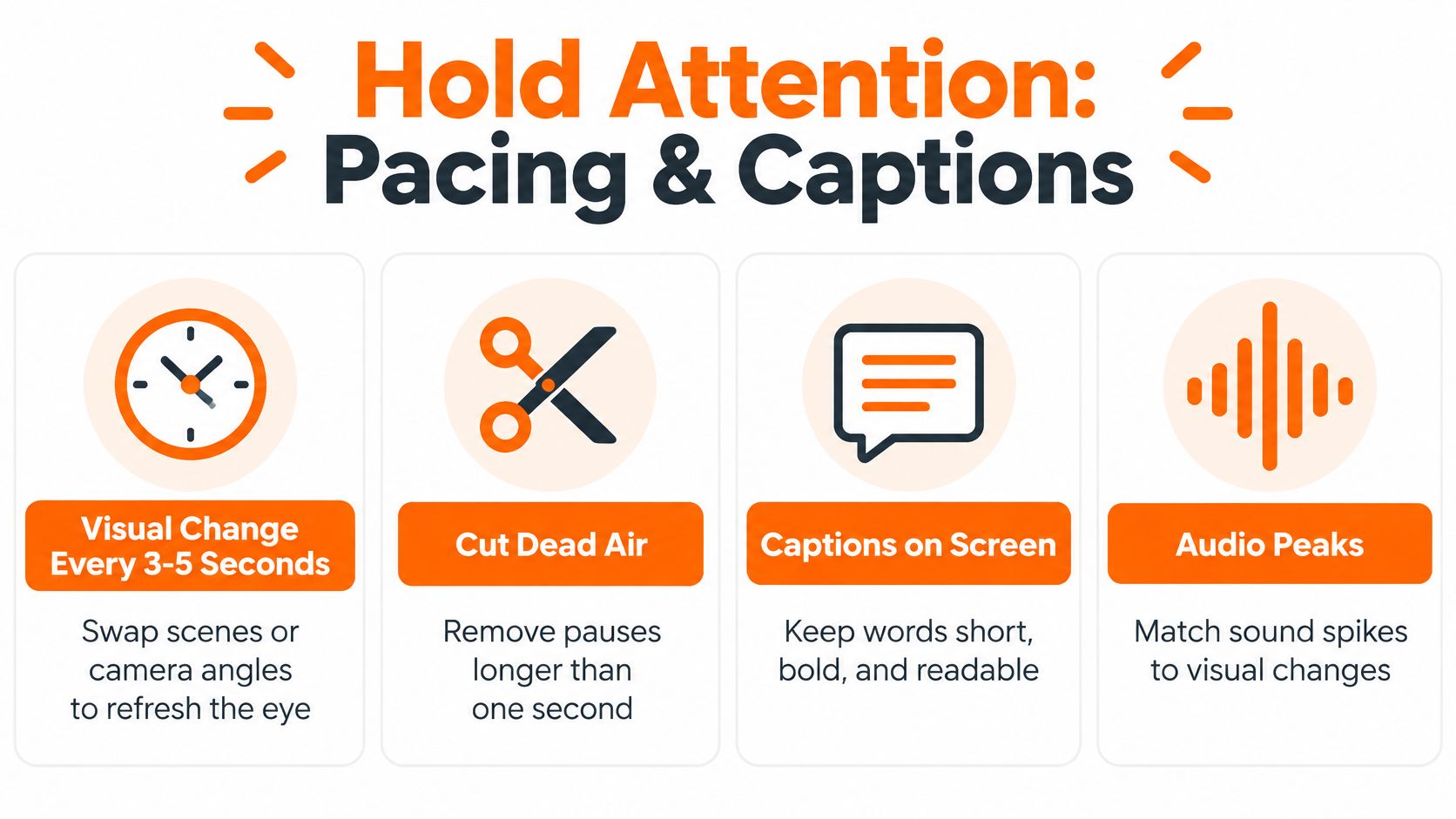
Introduce a visual or information change every few seconds. That can be a tighter crop, a different angle, a zoom on the relevant detail, an on-screen result, or a new sentence that changes what the viewer expects. A cut that changes nothing is decoration.
Trim pauses at the syllable level. Breaths before sentences, laughs that run past the joke, and reaction shots held for politeness all invite swipes. Keep a reaction only if it sells the payoff, confirms surprise, or sets up the next beat. Otherwise it’s filler wearing a human face.
Transitions should clarify time or place, not show off. If you’re unsure which ones help a vertical cut stay readable, the guide on how to make transitions that serve the cut covers the practical choices without turning every edit into an effects reel.
Caption for Muted, Phone-Size Viewing
Captions aren’t subtitles pasted on at export. They’re your second hook. Keep phrases short enough to read without pausing, place them where faces and hands don’t fight the text, and keep the subject centered in the 9:16 frame. If viewers must choose between watching the action and reading a paragraph, they’ll leave.
- Caption chunks: Short phrases that track speech closely, not full sentences lagging behind.
- Contrast and size: Readable at arm’s length on a phone, even over busy game footage.
- Speaker focus: Reframe so the person delivering the key line stays visible, not cropped at the edge.
- Audio peaks: Let a sound spike land with a visual change so ears and eyes reset together.
Tools can speed up this unglamorous work. ClipOven, for example, converts horizontal footage to 9:16 with subject-focused reframing and animated captions you can refine on a timeline. That’s useful only if you still audit the result. Automated captions mishear names, and automated reframing can follow the wrong player in a crowded scene.
Audit every draft in silence once and with sound once. Note the exact second you feel tempted to look away. That’s rarely random. It’s usually a pause, a repeated point, or a caption block you couldn’t finish reading.
Choosing the Right Length for the Idea
“Make it shorter” sounds decisive, so people keep repeating it. It’s bad advice when it removes the context that makes a payoff satisfying. Length should follow information density, which means how much setup a stranger needs before the result means something.
Recent cross-platform analysis found TikToks lasting one to three minutes reached one million views 1.85% of the time, compared with 0.43% for videos under ten seconds, while Shorts longer than one minute achieved only 0.81 times the median views of shorter Shorts, according to cross-platform short-form trend analysis. The lesson isn’t “go long.” It’s that platforms and ideas don’t share one ideal length.
A Simple Length Decision
First remove dead air. Then ask one question: does the payoff need setup to land? A jump scare, dance hit, or visual gag may need almost none. A tutorial fix needs the problem shown before the solution earns trust. A streamer clip may need the bad call that makes the comeback funny.
| Idea Type | Best Starting Cut | Watch For |
|---|---|---|
| Visual gag or feat | Hook-only, start at the peak action | Confusion if viewers can’t tell what happened |
| Comeback or failure story | Setup plus payoff, show the mistake first | Middle drop-off if setup repeats itself |
| Tutorial or explanation | Full context, problem, steps, result | Viewers leaving before the proof appears |
| Hot take or claim | Claim first, then one supporting example | Comments arguing because proof arrived too late |
Test the same moment at three lengths rather than guessing once: hook-only, setup-plus-payoff, and full-context. Keep captions, audio, and opening frame consistent so duration is the variable. Compare early retention, completion, shares, and follows, because the shortest cut often wins completion while losing shares.
That trade-off is normal. A tight clip can be easy to finish and too thin to send to a friend. A slightly longer version gives viewers a story they can describe in a message, which is often how sharing starts.
For Shorts specifically, length also interacts with how the title and opening frame set expectations. The breakdown of how long a YouTube Short should be is useful background when you’re deciding whether a longer Shorts cut deserves a test or belongs on TikTok instead.
Editing Differently for TikTok and YouTube Shorts
Posting the identical file to TikTok and Shorts feels efficient. It also assumes both feeds reward the same behavior, and they don’t always move together. An analysis of nearly six million short-form videos found TikTok reach fell 47.19% while engagement rose 35.61%, whereas YouTube Shorts reach declined 31.42% and engagement declined 36.12%, as reported in analysis of short-form engagement patterns.
That’s why strong engagement can sit next to weak distribution. Interaction rate, watch duration, completion, rewatches, shares, and eligible audience size are separate levers. A loyal niche can comment heavily while the clip fails to hold cold viewers long enough to travel.
What to Change Between Platforms
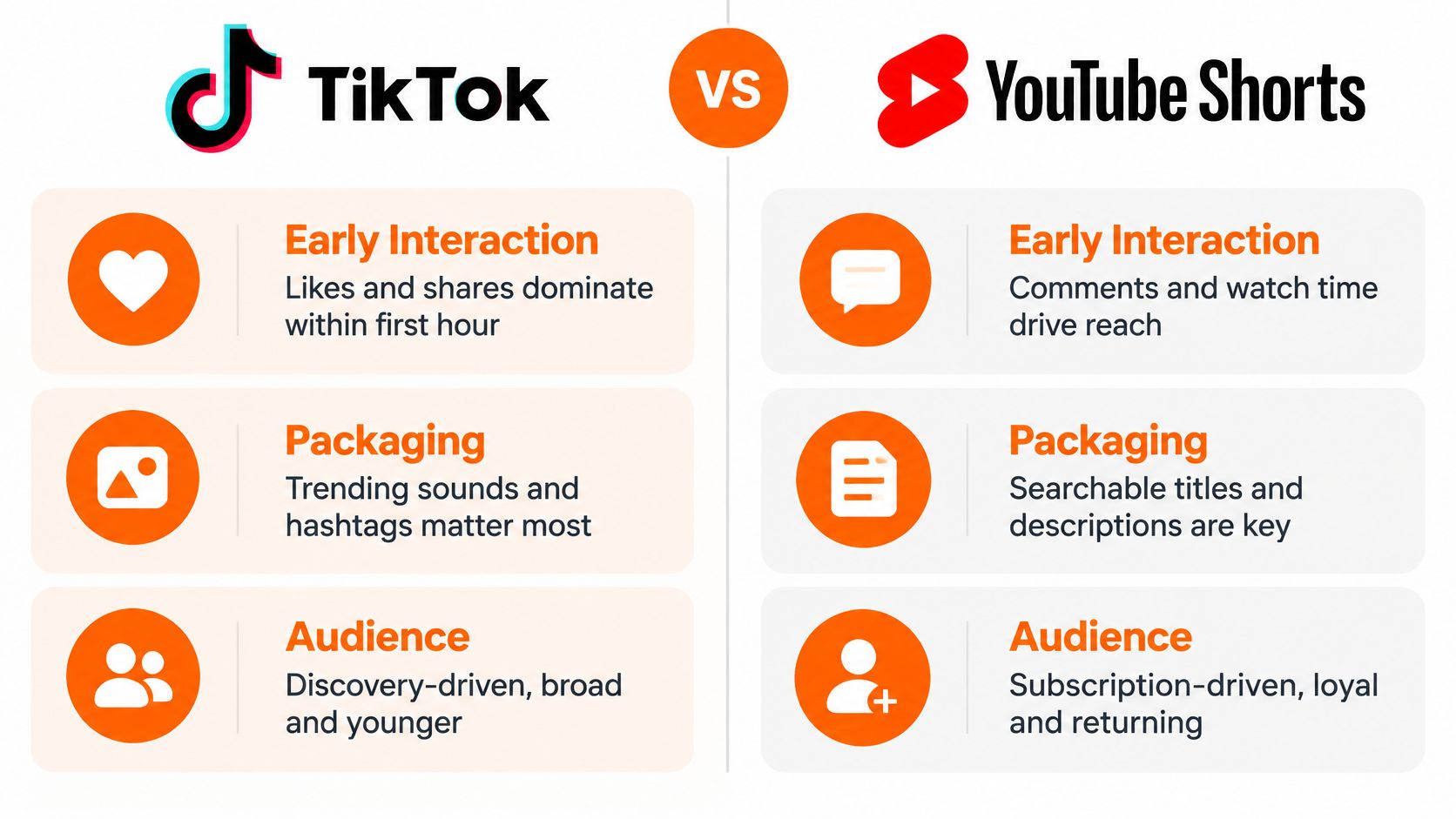
On TikTok, concentrate the opening and give viewers an early reason to respond, save, or share. Denser captions and a faster first beat can work because discovery is the whole game. On Shorts, packaging and continuity matter more: a searchable, honest title, a first frame that matches it, and a topic your existing viewers recognize as yours.
The practical guide to YouTube Shorts editing choices goes deeper on the Shorts side. In day-to-day work, the split looks like this:
- TikTok version: Tighter opening context, punchier first caption, payoff teased immediately.
- Shorts version: Clearer title alignment, slightly more context for returning viewers, ending that loops or points naturally to related content.
- Both versions: Same core payoff, different pacing and packaging. Not different videos pretending to be one post.
Watch how the contrast plays out in a real vertical edit before you recut your own footage:
Judge each platform with its own funnel: initial hold, average watch time, completion or rewatch, shares, comments, then profile or channel actions. Calling a post a failure because views were low hides which stage broke. A TikTok with strong shares but modest reach may need a stronger first frame. A Short with good reach but no subscribers may need a clearer series promise.
Running a One-Variable Test on Every Clip
Most creators don’t have a content problem. They have an attribution problem. They change the hook, length, music, captions, and title at once, see a different result, and learn nothing they can repeat.
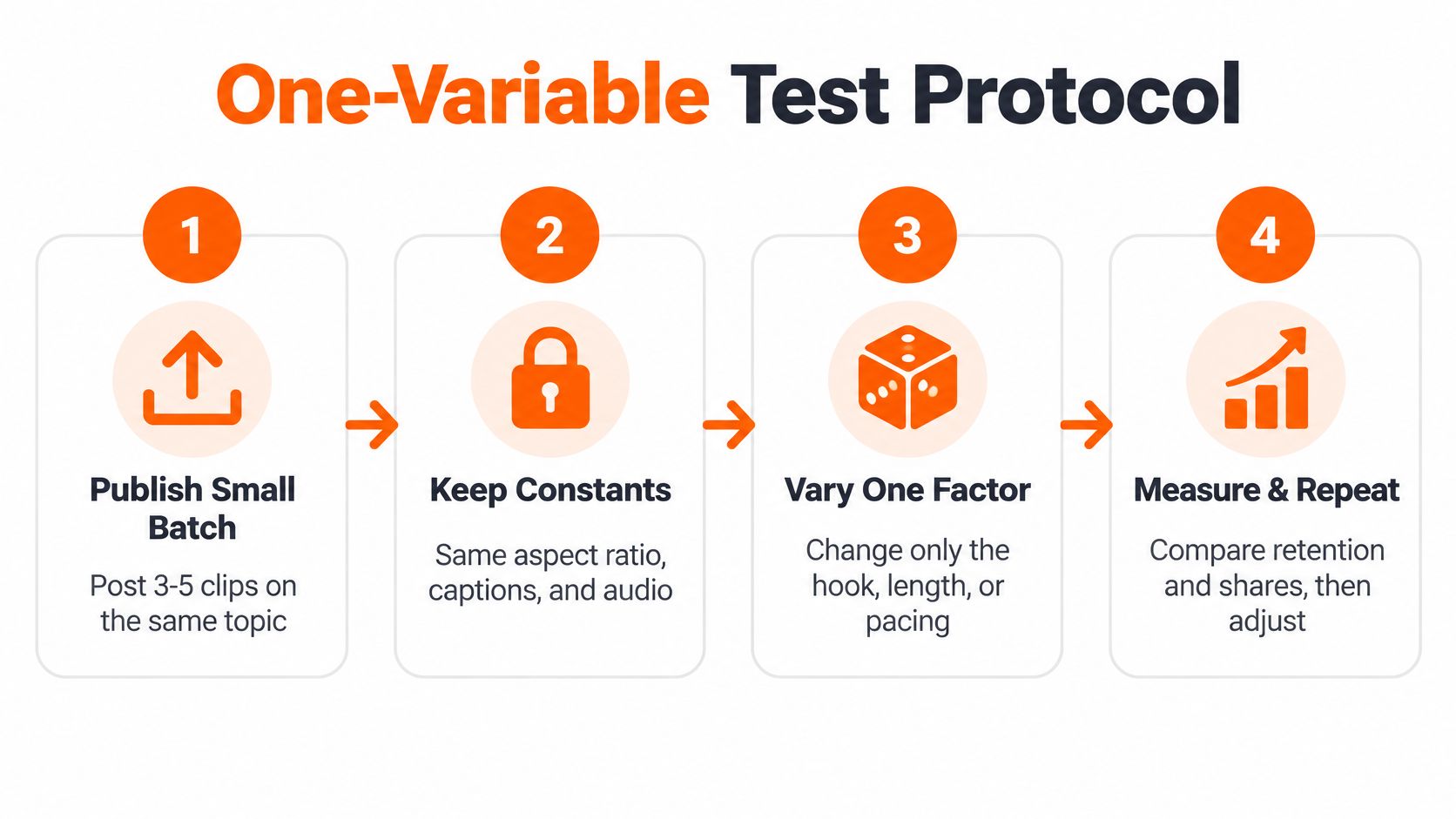
The Controlled Batch
Publish a small batch on a consistent topic with the same aspect ratio, caption readability, audio level, and posting cadence. Vary one major factor only: opening frame, clip length, caption treatment, or payoff placement.
- Lock the constants: Topic, format, caption style, and audio approach stay fixed.
- Change one variable: For example, result-first opening versus question opening.
- Record the funnel: Viewed versus swiped away where available, average view duration, average percentage viewed, completion, shares, comments, and rewatches.
- Re-edit the failure zone only: Don’t rebuild a clip whose only problem is its final three seconds.
Benchmark guidance identifies 70% or more average percentage viewed as a healthy Shorts target, below 50% as a likely structural issue, and over 100% as evidence of replaying, with caution that comparisons should use similar videos, as explained in YouTube audience retention benchmark guidance. Treat those as diagnostic flags for your channel, not universal laws.
Read the Curve by Failure Zone
- Steep drop in the first seconds: The visual premise or first words didn’t match what viewers expected. Replace the first frame or opening line.
- Gradual middle decline: Pacing or information density sagged. Tighten pauses, remove repeated points, shorten reaction shots.
- Strong curve, final drop: The payoff already landed and you kept talking. Cut the branded outro and end on the result.
Diagnostic habit: Name the failure zone before you touch the timeline. “Weak hook” leads to a different edit than “slow middle,” even when both videos have low views.
I find the final-drop pattern the most frustrating because the clip already worked. Creators add a polite “follow for more” after the laugh, completion falls, and the replay moment disappears. Put the ask earlier in captions if you must, or let the content earn the profile tap.
Keep a simple log with source timestamp, variant, length, and the four metrics above. After a few batches, patterns get blunt. Your audience may love contradiction hooks on tutorials and ignore them on gameplay. That specificity is worth more than any general list of viral tips.
A 90-Day Iteration Plan for Reach That Compounds
Ninety days is long enough to stop guessing and short enough to stay honest. You’re not chasing one freak hit. You’re building a library of proven payoffs, hooks, and lengths for your specific audience.
Weeks 1 to 2 Set the Baseline
Standardize your export settings, caption style, framing approach, and logging sheet. Publish your normal clips without heroic changes. You need a baseline for average percentage viewed and shares before you declare any later result an improvement.
Weeks 3 to 6 Test Openings and Lengths
Run one-variable batches on hooks first, then durations. Keep the topics close enough that comparisons mean something. Retire openings that repeatedly lose in the first seconds, even if you personally like them.
- Fridays: Review retention curves, not just view counts.
- Keep: Two winning hook styles and one reliable length per idea type.
- Cut: Greetings, long outros, and any recurring segment that causes mid-clip decline.
Weeks 7 to 12 Split by Platform and Double Down
From week seven, produce separate TikTok and Shorts versions of your strongest source moments. Adjust opening context, caption density, and title packaging rather than rebuilding from zero. In the final two weeks, reshoot or recut your best-performing payoffs with the winning structure and retire formats that never produced shares or channel actions.
Track four metrics that predict whether reach can compound: average view duration, completion or rewatch rate, shares, and profile or channel actions. Views still matter, but a video with modest views and high shares is a better lead than a high-view clip nobody finished. The first shows you a transportable idea with a distribution problem. The second shows distribution you probably can’t repeat.
Expect most clips to be average. That’s not failure, it’s sampling. Each batch narrows what your viewers finish and forward, so your next recording session starts with better raw material and clearer editing decisions. That compounding knowledge, not a trend you copied on Tuesday, is what makes a viral result more likely over time.
Turn one long recording into multiple platform-specific cuts without rebuilding every edit by hand: clipoven converts horizontal footage into 9:16 shorts with reframing, captions, and an editable timeline you can refine through chat. Bring a stream, podcast, or tutorial recording and test your first hook variants from the same source moment today.